

AMENDMENT 4 OVERVIEW : VOTE NO
Amendment 4 would effectively eliminate use of the initiative petition process to change the Missouri Constitution by setting an impossibly high bar for voter ratification of future constitutional amendments proposed by petition. It will appear on the Aug. 4 statewide ballot.
The Missouri General Assembly placed Amendment 4 before voters with the passage of House Joint Resolution 3 during a September 2025 special legislative session called by Republican Gov. Mike Kehoe. State Rep. Ed Lewis, R-Moberly, sponsored HJR 3, which passed on near-party-line votes of 98-58 in the House of Representatives and 21-11 in the Senate.
Just six Republicans in the House and one in the Senate joined unanimous Democrats in opposing the measure. Notably, the handful of opposition Republicans included House Speaker Jon Patterson, R-Lee’s Summit, who could have used his leadership position to block HJR 3 but chose not to, likely due to his party’s overwhelming support for it.
Ratifying an amendment to the Missouri Constitution has always required a simple majority of the statewide vote cast, regardless of whether the amendment was placed on the ballot by the legislature or the initiative petition process, which allows citizens to bypass lawmakers and send issues directly to voters.
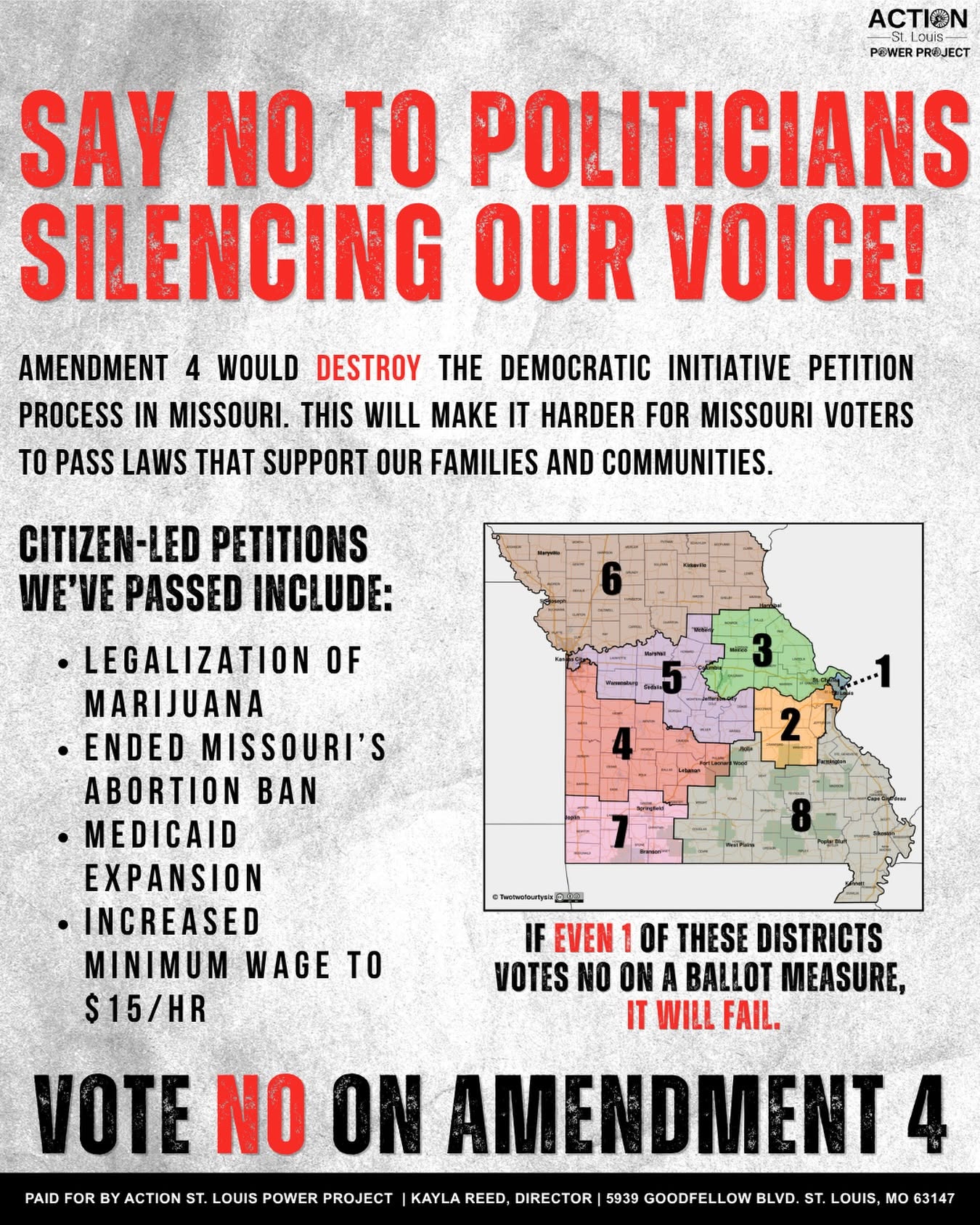
While retaining the simple statewide majority requirement for measures proposed by the legislature, Amendment 4 would substantially raise the bar for amendments proposed by initiative petition, requiring them to win majorities in all of Missouri’s eight congressional districts. As a result, failure to pass in a single district would result in a measure being rejected – even though a majority of Missourians supported it.
According to an analysis by the Missouri Independent, an online news organization focusing on state government, it would be mathematically possible for a measure to win 95 percent of the statewide vote but narrowly fail in a single congressional district, resulting in just 5 percent of voters vetoing the wishes of an overwhelming majority.
Although by default the Secretary of State’s Office prepares the ballot language for measures placed before voters, the General Assembly exercised its prerogative under state law to write its own ballot question as part of HJR 3. However, a lawsuit challenged that language for being deceptive by focusing on so-called “ballot candy” designed to elicit a “yes” while downplaying the measure’s main purpose of making it impossible to ratify initiatives.
In a Feb. 19 ruling in T. David Rogers v. Secretary of State Denny Hoskins, et al. (25AC-CC07983), Cole County Judge Dan Green, a Republican, stripped the ballot candy references from the ballot language, ruling those provisions of Amendment 4 merely described existing law. He rewrote the question to focus on Amendment 4’s changes to the majority requirements for ratification. The state opted not to appeal Green ruling.
Green’s rewritten language for Amendment 4, followed by the official fiscal estimate prepared by the State Auditor’s Office, says:
Shall the Missouri Constitution be amended to:
- Modify current requirements that a statewide majority of voters may approve initiative petitions to amend the constitution;
- Require a majority of voters in each congressional district to approve initiative petitions to amend the constitution; and
- Make available to each voter the full text of initiative petitions with their ballot?
The Department of Corrections estimates increased annual costs of up to $21,817. The Office of the State Public Defender estimates an unknown fiscal impact. Other state governmental entities estimate no costs or savings. Local governmental entities estimate no costs or savings.
Two campaign committees have filed with the Missouri Ethics Commission to oppose Amendment 4, with Missourians for Fair Governance being the more active. It is largely funded by the Missouri Association of Realtors, which used the initiative process to successfully push for two relatively recent constitutional amendments that voters ratified in 2010 and 2016.
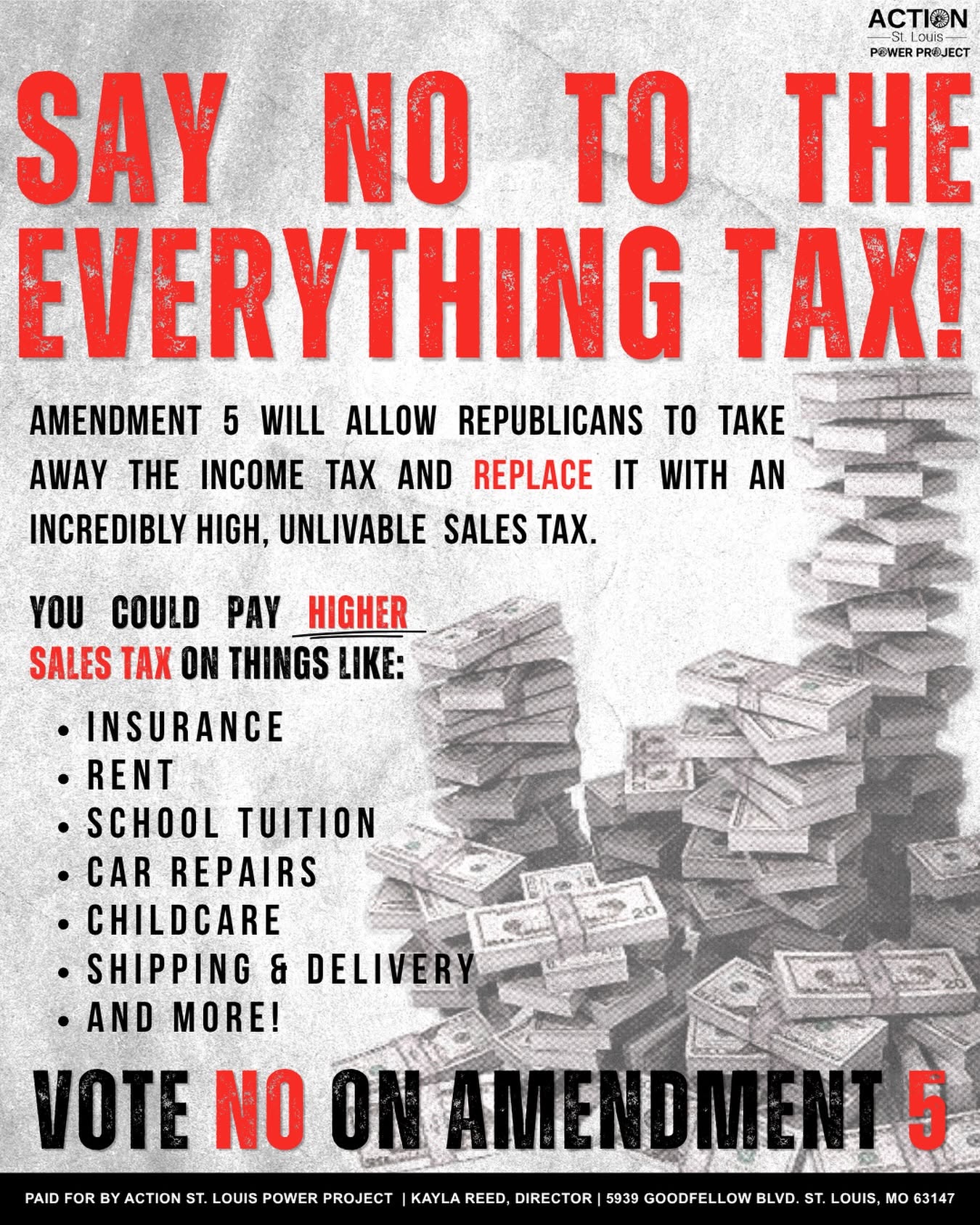
The first prohibits imposing sales taxes on real estate transactions while the second bans sales taxes on services. Both amendments would be nullified by a separate measure the Republican-controlled legislature sent to voters that also is on the Aug. 4 ballot. That measure, Amendment 5, would empower lawmakers to massively expand sales tax on “any goods and services” to provide replacement revenue for eliminating the state’s individual income tax.
The other opposition group, Protect Majority Rule Missouri, had raised nearly a half-million as of its April disclosure report but so far has not been a visible campaign presence. As of this writing, no campaign group had been formally established to support Amendment 4.
ARGUMENTS IN SUPPORT OF AMENDMENT 4
The Missouri Constitution is too easy to amend and has been changed a whopping 138 times since the state’s current state constitution was ratified in 1945. By contrast the U.S. Constitution has only been amendment 27 times in 237 years.
Because the initiative process bypasses elected lawmakers, it encourages out-of-state special interests to propose constitutional amendments that advance their agendas. Setting a higher ratification threshold is a way to ensure Missourians truly support changes to their constitution.
Initiatives making sweeping constitutional changes frequently are ratified on the strength of support concentrated in the state’s two major metropolitan areas, while voters in most Missouri counties oppose them, enabling voters in the Kansas City and St. Louis area to dictate policy to the rest of the state.
All Missourians from all regions of the state should decide amendments proposed by the initiative. Requiring an amendment to win a majorities in all eight districts will guarantee that statewide ballot measures actually do enjoy statewide support.
Keeping the traditional simple majority in place for constitutional amendment proposed by lawmakers makes sense since, unlike initiative petitions, those measures have been properly vetted by the elected representatives of the people.
By setting a higher bar for constitutional amendments, Amendment 4 will encourage more statutory initiatives that propose changes to state law and stop cluttering the constitution with provisions that would better serve Missourians in statute where lawmakers could more easily make changes if necessary.
ARGUMENTS IN OPPOSITION TO AMENDMENT 4
Article I, Section 1 of the Missouri Constitution says: “That all political power is vested in and derived from the people; that all government of right originates from the people, is founded on their will only, and is instituted solely for the good of the whole.”
Amendment 4 is a nakedly partisan attempt by Republicans elected officials to strip Missourians of their power in defiance of a fundamental principle on which this state was founded – that power originates with and belongs to the people, not the government.
Amendment 4 violates the fundamental principle of majority rule, making it mathematically possible for just 5 percent of voters to subvert the will of the other 95 percent. That is inherently unfair in a democracy.
Missouri is a single state, and statewide ballot measures should be decided by a majority of all Missouri voters, without regard for what part of the state they live in.
Amendment 4 will effectively kill the initiative process as it applies to constitutional amendments since no one will bother with the time and expense of using it to put an amendment on the ballot knowing that with the impossibly high bar for ratification, failure is guaranteed.
It is simply unconscionable for Amendment 4, which was written by lawmakers, to preserve the simple majority requirement for future amendments proposed by lawmakers while imposing an unrealistic standard for citizen initiatives. The rule should remain the same for both.
AMENDMENT 5 OVERVIEW: VOTE NO
Amendment 5, which will appear on the Aug. 4 statewide ballot, would override several existing constitutional restrictions against increasing taxes – including bans on taxing services or real estate transactions and a requirement that voters must approve any major tax hike – and authorize state lawmakers to significantly expand sales and use taxes on “any goods and services.” The revenue generated by the expanded sales and use taxes would be used to gradually reduce, and ultimately eliminate, the state’s individual income tax, which currently provides about two-thirds of state general revenue.
The Republican-controlled Missouri General Assembly placed Amendment 5 on the statewide ballot with the passage of House Joint Resolution 173 & 174 during the 2026 legislative session. The measure, sponsored by House Speaker Jon Patterson, R-Lee’s Summit, and state Rep. Bishop Davidson, R-Republic, was Gov. Mike Kehoe’s top legislative priority. It passed on final votes of 18-11 in the Senate and 95-59 in the House of Representatives. Just 12 Republicans – three senators and nine representatives – joined unanimous Democrats in opposing it.
Supporters of Amendment 5 say Missouri’s economy has stagnated in recent decades – an odd claim for Republicans to make since they have controlled both legislative chambers and directed state economic and tax policy for the last 24 years – and that restructuring the tax code to end state government’s reliance on income taxes will bolster future economic growth. By eliminating the state tax on individual income and replacing it with a broad-based tax on consumption, supporters claim it will spur business investment, create high-paying jobs, attract new residents and allow Missouri to better compete with states that already don’t levy an income tax.
If ratified by voters, however, Amendment 5 would produce the largest shift in the state’s tax burden in living memory. While the wealthiest 20 percent of Missouri taxpayers would enjoy a net tax cut, the remaining 80 percent would experience an overall tax increase as the minimal savings low- and middle-income taxpayers would receive from eliminating the income tax would be exceeded by the increased sales taxes they would pay, according to an analysis by the Missouri Budget Project, an independent think-tank that studies state revenue and spending.
The tax shift would hit senior citizens especially hard. Since Social Security benefits are already exempt from the state income tax, Missourians who rely on Social Security as their primary source of income would enjoy no benefit from eliminating the tax. But with substantially higher sales and use taxes levied on all goods and services they buy, those senior citizens would pay a much larger share of their income in taxes than they currently do.
Sales taxes apply to purchases made within Missouri, while compensating use taxes are levied on items buyers located in Missouri purchase from out-of-state vendors. Exactly how high those taxes would increase is unclear, as Amendment 5 leaves it to future lawmakers to make those decisions in yet-to-be-drafted legislation.
However, since the individual income tax annually provides about two-thirds of Missouri’s General Revenue Fund – approximately $9.33 billion for the 2027 fiscal year, the increase would need to be substantial, likely pushing the statewide sales and use tax rate from its current 4.225 percent into double digits. With local taxes added on top of that, overall rates could hit 20 percent in some places.
The Missouri Supreme Court declined to hear the state’s appeal in the case, allowing the Western District’s rewrite of the ballot summary to stand. The replacement ballot question, followed by the official fiscal estimate prepared by the State Auditor’s Office, says:
Shall the Missouri Constitution be amended to:
- Require legislative phase-out of the individual state income tax based on revenue growth, and authorize the expansion of sales and use taxes;
- Curtail constitutional limits on taxing goods and services; and
- Require local tax rate cuts without reducing school funding if local sales tax revenue increases?
The proposal has no direct impact on state or local tax revenue. If passed, implementing legislation will have an unknown impact to state and local tax revenue. If implemented, state government entities expect a reduction of $57,000 annually in income tax check-off donations and implementation costs of at least $100,000.
Support for Amendment 5 is being led by Missouri Promise PAC, a political action committee led by Marc Ellinger, a Jefferson City attorney long involved with Republican-backed political campaigns and lawsuits. Its efforts are being funded by the similarly named Missouri Promise Inc., a shadowy Delaware-based nonprofit that doesn’t publicly disclose its donors.
The campaign committee Missourians for Fair Taxation is leading the opposition to Amendment 5. It is largely funded by the Missouri Association of Realtors, which was responsible for initiative petition drives in 2010 and 2016 that respectively led to voters banning sales taxes on real estates transactions and services. Amendment 5 would override both prohibitions.
WHY CHANGE THE CONSTITUTION?
From a legal standpoints, a voter-approved constitutional change isn’t necessary to reduce or eliminate the state’s individual income tax. In fact, the Republican-controlled legislature has enacted laws reducing the rate several times since 2014. While the top rate had remained at 6 percent for more than four decades, it currently stands at 4.7 percent, with a further reduction to 4.5 percent already in law and set to take effect once certain revenue growth triggers are met.
In addition to repeatedly lowering the income tax rate, lawmakers have provided a variety of income tax exemptions in recent years, including eliminating state taxes on investment income last year – a move that is costing the state more than $500 million a year in lost revenue. The various tax cuts have contributed to recent state budget cuts and Missouri’s continuing struggles to maintain funding for basic state services, with additional cuts expected in the coming years.
Although lawmakers could continue lowering the individual income tax rate to zero without getting voter permission, since that tax provides about two-thirds of general revenue, state government couldn’t survive such a substantial a funding loss without providing for replacement revenue.
Because it wouldn’t be realistic for lawmakers to generate enough new sales tax revenue to replace the income tax through rate hikes alone, an expansion of the sales tax and use base to allow for services to be taxed in addition to goods is necessary. And that requires changing the Missouri Constitution to override existing constitutional prohibitions on taxing services and real estate transactions and authorize lawmakers to expand those taxes without voter approval.
AMENDMENT 5 PROVISIONS
Amendment 5 purports to require the General Assembly to “enact legislation to reduce and eliminate the state individual income tax” by reducing the top income tax rate based on unspecified future revenue growth. Once the individual income tax rate is reduced to zero, lawmakers would be constitutionally prohibited from reinstituting the tax.
But Amendment 5 doesn’t specify how that requirement would be enforced if lawmakers are unable to agree on legislation to eliminate the individual income tax and replace it with substantially expanded sales and use taxes covering more types of transactions, including many not currently taxed. Since legislative power is exercised at the discretion of the legislature, there doesn’t appear to be any legal mechanism for forcing action in case of an impasse.
On paper, Amendment 5 leaves in place the existing constitutional bans on taxing real estate transactions – ratified by 83.7 percent of Missouri voters in 2010 – and services – approved in 2016 with 57 percent support. However, it renders both provisions unenforceable by granting lawmakers vast authority “to impose taxes and transactions involving any goods and services”
and empowers them to exercise that authority “notwithstanding any provision of this constitution to the contrary,” meaning any constitutional limitations on their taxing power would be nullified.
During his State of the State address in January, Kehoe claimed that he “will never support extending sales taxes on agriculture, health care or real estate. Period.” Despite that promise, Amendment 5 includes no such exemptions and in fact overrides the existing constitutional prohibition against taxing real estate transactions.
While special exemptions could be provided in the future legislation that would implement the sales tax expansion, any and all goods and services would be subject to sales and use taxes under Amendment 5 until and unless the legislature says they aren’t. As a result, there likely would be a feeding frenzy by lobbying groups seeking to secure sales and use tax exemptions that protect their financial interests. But the more exemptions lawmakers provide, the smaller the sales tax base would become and the higher the sales and use tax rates would have to go to deliver the same amount of revenue.
Amendment 5 would exempt any sales and use tax increases the legislature imposes over a five-year period ending in September 2031 from an existing constitutional provision requiring voters to approve all proposed tax hikes over a certain amount – currently about $150.5 million in given year. It also overrides in perpetuity another constitutional requirement earmarking tax revenue from motor vehicle sales for state and local transportation projects.
Because local governments follow state law in determining what sales are subject to taxation, Amendment 5 would require them to reduce local taxes so that they wouldn’t profit from the greatly expanded tax base. For most local governments, the options would be either to lower their local sales and use tax rates or reduce property taxes. Kansas City and St. Louis would have the additional option of reducing or eliminating their 1 percent local earnings taxes, which only those two cities are authorized to levy.
While Amendment 5 purports to prohibit local governments from cutting local taxes in a manner that reduces local funding for public schools, this is just “ballot candy” – a provision added to a measure to entice a “yes” vote – that would have little to no practical impact since public school districts rely on property taxes for their local revenue and do not levy sales taxes, while cities, counties and the other political subdivisions that do levy sales taxes don’t fund public schools.
The final provision of Amendment 5 requires that two sales and use tax rates currently authorized in the Missouri Constitution – a 1/8-cent tax for the Department of Conservation and a 1/10-cent tax for the Department of Natural Resources – be reduced so that each generates the roughly same amount of revenue after the tax base is expanded that they did prior to expansion.
TAXING ‘BIG TECH’?
Ads paid for by Missouri Promise argue that Amendment 5 would force “big tech” companies to pay more Missouri taxes and strongly imply that this alone would allow for the state income tax to be eliminated, claiming: “Amendment 5 makes big tech pay so you don’t have to.”
However, no provision of Amendment 5 would create a new tax targeting technology companies or authorize the legislature to create one later. Rather, the basis of the claim is that by nullifying the existing constitutional ban on taxing services, the state could begin imposing sales and use taxes on all manner of digital services, including monthly television streaming subscriptions such as Netflix, Hulu and Disney+.
Kehoe himself admitted during his 2026 State of the State address in January that levying state taxes on currently untaxed digital subscriptions and services is one of his goals.
“Our plan pairs tax relief with closing loopholes,” Kehoe said. “Today, much of our commerce happens through monthly subscriptions and digital services like online advertising, e-books and AI platforms that fall outside our current sales tax base. Their billionaire owners don’t pay.”
However, neither technology companies nor their “billionaire owners” would pay the new sales and use taxes on digital services Kehoe wants to impose. Instead, Missouri consumers would pay those taxes at the point of purchase, just as they currently do when buying tangible goods.
ARGUMENTS IN SUPPORT OF AMENDMENT 5
Eliminating the state’s individual income tax will keep more money in the paychecks of working Missourians, who can decide how to spend their money much better than government.
Missouri’s 20th century tax structure is woefully out of date and in need of a major overhaul to enable our state to compete in the 21st century economy.
While Missouri’s economy – and population – have stagnated over the last couple decades, states like Florida, Texas and neighboring Tennessee that don’t have individual income taxes have thrived, attracting investment, jobs and residents. Missouri could have the same experience if Amendment 5 passes.
Much of the modern economy is digitally based, yet Missouri currently is prohibited from imposing any taxes on this key sector. Amendment 5 will fix that.
The phase-out of the individual income tax will be done deliberately and responsibly to ensure state government remains on sound financial footing and can continue to meet its obligations.
At the local level, expanding the sales tax base will allow local property taxes to be reduced, providing homeowners with much-need financial relief.
ARGUMENTS IN OPPOSITION TO AMENDMENT 5
Although absolutely no one in Missouri is clamoring for higher sales taxes, Amendment 5 authorizes lawmakers to impose sales taxes on literally everything Missourians buy.
Haircuts, car repairs, doctor’s visits, digital subscriptions, rent, home purchases, emergency visits from the plumber – any good or service you can think of would be subject to taxation under Amendment 5.
This would be the largest shift in the tax burden in Missouri history, granting a net tax cut to the wealthiest 20 percent while the remaining 80 percent get smacked with a big tax increase.
Amendment 5 would hit senior citizens the hardest. Since Social Security currently isn’t subject to state income taxes, senior citizens would enjoy no benefit from the tax’s elimination, but the substantially expanded sales tax would take a huge chunk out of their limited budgets.
While Amendment 5 gives local governments the option of cutting local property taxes, it doesn’t require it. Supporters’ claims that it definitely would reduce property taxes are false.
In addition, the bulk of local property tax revenue goes to local school districts, which don’t charge sales taxes and therefore wouldn’t have replacement revenue to lower their property tax levies.
Amendment 5 gives lawmakers vast authority to expand sales taxes – overriding voter-approved bans on taxing real estate transactions and services – while eliminating voter oversight.
When neighboring Kansas tried its failed tax-slashing experiment a decade ago, its people were promised prosperity and instead got financial crisis until Kansas lawmakers reversed course.
If Missouri lawmakers get their revenue-replacement calculations wrong and bankrupt the state, their financial mismanagement couldn’t be easily reversed, unlike in Kansas, since Amendment 5 would prohibit them from reinstating the income tax.
AMENDMENT 1 OVERVIEW: VOTE YES
If ratified by Missouri voters on Aug. 4, Amendment 1 would reauthorize for another 10 years the existing 1/10-cent statewide sales and use tax for the Missouri Department of Natural Resources. The tax generates roughly $140 million a year, with half of the revenue constitutionally dedicated for soil and water conservation programs and the other half for the operation and maintenance of state parks and historical sites.
Missouri voters first authorized the soil and water conservation/state parks tax in August 1984 with 50.1 percent support. It was set to expire after five years, but voters subsequently granted the tax four, 10-year extensions. Despite it barely passing in 1984, voters have overwhelmingly approved it every time since then, with support hitting almost 80 percent the last time out. Those “yes” votes:
Amendment 7 November 1988 68.7 percent
Amendment 8 November 1996 66.6 percent
Amendment 1 August 2006 70.8 percent
Amendment 1 November 2016 79.9 percent
The General Assembly placed the original 1984 measure on the ballot. Initiative petition drives led to the first two renewal votes, in 1988 and 1996.
When lawmakers passed the legislation placing the 2006 renewal amendment on the ballot, they added a provision that automatically resubmits the tax to voters every 10 years, assuming continuous renewal. As a result, neither new legislation nor an initiative petition was required to put the issue back before voters in 2016 or 2026.
If voters ratify this year’s Amendment 1, the tax will continue for another decade and be subject to a renewal vote again in 2036. If Amendment 1 is defeated, the tax will expire as of July 1, 2028, reducing Missouri’s overall statewide sales tax from the current 4.225 percent to 4.125 percent, saving taxpayers one penny for every $10 spent – or, to put it another way, $1 for every $1,000 spent.
According to the Department of Natural Resources, the soil and water conservation programs, which help combat soil erosion and the resulting contamination of water supplies, are entirely funded by the dedicated sales tax. The state parks system derives 75 percent of its funding from the tax.
In the event the tax isn’t renewed, lawmakers would have to fund to the soil and water conservation programs and the state parks system out of general revenue, which would leave less money available for other state services, including education, health care and public safety.
The 1/10-cent statewide soil and water conservation/state parks tax is not to be confused with a separate 1/8-cent statewide sales and use tax that funds the Missouri Department of Conservation. The latter tax, established by voters through a constitutional amendment ratified in 1976, is permanent and not subject to periodic renewal.
The ballot language prepared for Amendment 1 by the Secretary of State’s Office, followed by the official fiscal estimate prepared by the State Auditor’s Office, says:
Shall Missouri continue for 10 years the one-tenth of one percent sales/use tax that is used for soil and water conservation and for state parks and historic sites, and resubmit this tax to the voters for approval in 10 years?
The measure allows continued collection of the existing sales and use tax, which generates revenue of approximately $140 million annually.
As of the date of this writing, no campaign committee had been established with the Missouri Ethics Commission to advocate for ratification of Amendment 1. However, every past renewal effort has been backed by a broad coalition of groups representing agricultural, environmental and recreational interests. That is expected to happen again this year.
Just as with previous renewal measures, there doesn’t appear to be any organized opposition to Amendment 1. However, Gov. Mike Kehoe’s decision to put it on the same ballot as Amendment 5 – his controversial proposal to massively expand sales taxes on any goods and services to generate enough money to replace the Missouri’s individual income tax, which currently provides about two-thirds of state general revenue – could prove problematic, raising concerns that voter backlash to the latter measure could imperil renewal of the parks and soil and water conservation tax.
ARGUMENTS IN SUPPORT OF AMENDMENT 1
Amendment 1 doesn’t increase taxes; it merely extends an existing tax that has been in place for more than four decades.
The tax costs just an additional penny for every $10 spent in Missouri – a bargain considering the state’s stellar state parks system and effective soil and water conservation efforts.
The state parks system is vital to Missouri’s tourism industry and attracts millions of visitors each year. Many of those visitors come from out of state, helping to contribute to the state’s economy by patronizing local businesses and paying state and local taxes.
Eliminating the tax would do nothing to help low-income Missourians. A family with a take-home income of $20,000 a year that spends every dime of it in Missouri would save only $20.
Eliminating the tax would blow a $140 million hole in the state budget, forcing lawmakers to make up the difference either by cutting spending for parks and soil and water conservation or reducing funding in other areas – such as education, health care or public safety.
ARGUMENTS IN OPPOSITION TO AMENDMENT 1
Sales taxes are regressive and disproportionately impact lower income Missourians who can least afford to pay.
Defeating Amendment 1 would provide a small, but deserved, tax cut that will put more money in the pockets of low-income Missourians.
Constitutionally dedicated taxes such as this one make it more difficult for lawmakers to prioritize how taxpayer money is allocated and ensure it is spent based on need. Instead, dedicated taxes protect spending for some parts of the state budget while other – perhaps more important – programs must compete for scarce general revenue dollars.
Nice though it is, the state parks system is a luxury, not a necessity. As a luxury, it shouldn’t enjoy a dedicated funding source while services that are far more essential to society are woefully underfunded.
AMENDMENT 2 OVERVIEW: VOTE YES
Amendment 2 would change the Missouri Constitution to clarify that Jackson County is required to have an elected – not appointed – county assessor. Although Amendment 2 will appear on the Aug. 4 statewide ballot, the issue is largely moot since Jackson County voters already approved a county charter change last year making the county auditor an elected position.
The Missouri General Assembly placed Amendment 2 before voters with the passage of House Joint Resolution 23 during the 2025 legislative session. State Rep. Carolyn Caton, R-Blue Springs, sponsored HJR 23. It passed on final votes of 33-0 in the Senate and 129-0, with 18 lawmakers voting “present,” in the House of Representatives.
Nearly six months later on Nov. 4, 2025, however, Jackson County voters rendered Amendment 2 unnecessary by approving a county charter amendment mandating the switch to an elected county assessor. The local measure, Question 1, passed with 88.2 percent of voters in support.
The Jackson County charter change notwithstanding, the state constitution already has required the county to have an elected county assessor following the release of the 2020 U.S. Census. Prior to that Census, Jackson County had enjoyed a constitutional exemption that allowed charter counties with more than 600,000 residents but less than 700,000 residents – a category applying only to it – to retain an appointed assessor.
While Jackson County had 674,158 residents under the 2010 Census, it’s population grew to 717,204 residents for the 2020 Census. Despite losing its constitutional exemption because of that population growth, Jackson County officials never implemented the switch to an elected assessor. Since no county resident filed a lawsuit to force the county to follow the constitutional requirement, the assessor remained an appointed position until local voters changed the county charter.
Amendment 2 simply deletes the constitutional exemption allowing appointed assessors in charter counties with more than 600,000 and less than 700,000 residents, while adding a new mandate that county assessors statewide “comply with all training provisions required by law.”
The official ballot question for Amendment 2 prepared by the Secretary of State’s Office, followed by the official fiscal estimate prepared by the State Auditor’s Office, says:
Shall the Missouri Constitution be amended to:
- require all charter counties, including Jackson County, to provide for the election of a county assessor; and
- require assessors in all charter counties to comply with any training requirements established by general law?
State and local governmental entities estimate no costs or savings.
COUNTY GOVERNMENT
As political subdivisions of the state, most counties have no inherent power and instead derive their authority from state laws passed by the General Assembly. Likewise, the structure of most county government offices is also determined by state law.
Article VI, Section 18 of the Missouri Constitution, however, allows voters in certain counties – those with more than 85,000 residents or those that achieve First Class status under the law based on countywide assessed valuation – to adopt a charter form of government. Charter government, also known as “home rule,” allows local voters to determine the structure and powers of their county government, so long as charter provisions don’t conflict with state law or the constitution.
While state law dictates what kinds of official positions most counties can or must have and whether those positions are elected or appointed, the constitution grants charter counties the authority to make most of those decisions locally.
Just four of Missouri’s 114 counties have charter forms of government, while a fifth – Clay County – recently adopted a county constitution, which likewise grants it the authority to determine the structure of its county offices, along with some additional powers.
St. Louis and Jackson counties were the only counties to have appointed assessors until 2011, when St. Louis County implemented a shift to an elected assessor following voter approval of a county charter change a year earlier. As a result, Jackson County has been alone in having an appointed assessor ever since.
ASSESSMENT CONTROVERSIES
In every odd-numbered year, county assessors are required determine the value of all real property in their jurisdictions. Assessed values of individual properties are used as the basis for determining real estate taxes owed by property owners.
As in Jackson County in recent years, assessment practices in St. Louis County had been controversial for well over decade prior to its switch from an appointed to elected assessor.
Then as now, critics of having an appointed assessor contend there is no accountability to taxpayers, which can result in assessed values being set too high, thus producing higher property taxes. Defenders of having an appointed assessor say shielding the position from voter wrath gives the assessor the necessary freedom to set fair and accurate assessments without fear of losing his or her job.
There has long been grumbling throughout the state that elected assessors intentionally undervalue property – thus shortchanging public schools and other taxing jurisdictions of their rightful share of tax revenue – in order to avoid angering property owners and being voted out of office.
Because of local anger over the situation in St. Louis County, the General Assembly enacted Senate Joint Resolution 5 during the 2009 legislative session placing a constitutional amendment on the November 2010 statewide ballot to require most charter counties to have elected assessors. Since there was no controversy over Jackson County’s assessment practices at the time, the drafters of SJR 5 exempted the county from the requirement, at least temporarily depending on its future population growth.
SJR 5 went on the ballot as Amendment 1, and voters ratified it with 74.1 percent in favor. But as with the current situation with Amendment 2 and Jackson County, by the time Amendment 1 went on the statewide ballot, St. Louis County voters had already resolved the issue by overwhelmingly voting to amend the county charter to make its county assessor an elected position. Coincidentally, the county charter change also passed with 74.1 percent support.
Although state lawmakers saw no cause to intervene in Jackson County at the time of the 2010 vote, assessment controversies similar to those that had earlier struck St. Louis County began roiling Jackson County less than a decade later.
While the county’s appointed assessor contended she was only bringing grossly undervalued properties closer in line with actual values in compliance with state law, many homeowners felt assessed values jumped so high, so fast that they couldn’t absorb the corresponding increases in property taxes and were at risk of being unable to afford their homes.
ARGUMENTS IN SUPPORT OF AMENDMENT 2
Appointed county assessors aren’t accountable to taxpayers. Such a lack of accountability in Jackson County resulted in assessments being set too high, resulting in higher taxes for property owners.
Every other Missouri county already has an elected assessor, who can be voted out of office for failure to do his or her job to the satisfaction of local taxpayers. Popular elections serve as a check against overly aggressive assessment practices.
Although Jackson County voters last year overwhelmingly endorsed switching to an elected assessor, Amendment 1 will ensure that the switch is permanent and not reversed in the future.
ARGUMENTS IN OPPOSITION TO AMENDMENT 2
The purpose of Amendment 2 – switching Jackson County to an elected assessor – has already been achieved locally by Jackson County voters, rendering a change to the Missouri Constitution unnecessary.
In fact, the state constitution already requires Jackson County to have an elected county assessor since the constitutional exemption it previously enjoyed no longer applies following the county’s population growth under the last U.S. Census.
The whole purpose of the existing constitutional provision authorizing counties to adopt charter forms of government is so county voters can establish rules that work best for them instead of being forced to adhere to one-size-fits-all directives from the state. Amendment 2 further undermines that local control.

