

If Missouri lawmakers are willing to pass legislation giving billionaires massive tax breaks through capital gains loopholes and incentive packages for professional sports teams, then we can certainly pass a law that supports the people who actually keep our state running. The Missouri Worker Dues Tax Fairness Act does just that. It recognizes that everyday Missourians: teachers, nurses, laborers, public employees, tradespeople, etc. They all deserve the same level of consideration and respect that wealthy elites receive as a matter of routine. This bill is a commitment to fairness: if we can invest in billionaires, we can invest in workers.
The bill allows Missourians to deduct up to $2,000 for individual filers and $4,000 for married couples for union dues, labor-organization dues, or dues paid to professional associations related to their employment. By making these dues tax-deductible, the legislation lowers the financial burden on workers who choose to organize, bargain collectively, and maintain professional credentials. It ensures that the people contributing to Missouri’s economy every single day, often in difficult or essential jobs, have meaningful financial support to participate fully in their unions and professions. The Missouri Worker Dues Tax Fairness Act is about putting working people first and giving them the tools to thrive.
As our state embraces the promise of artificial intelligence, we must also acknowledge the growing environmental cost of the infrastructure behind it. AI-optimized data centers consume massive amounts of electricity and water, contributing to escalating greenhouse-gas emissions, straining local water supplies, and threatening air and water quality for surrounding communities.
The AI Data Center Environmental Accountability Act brings accountability and transparency to this industry by requiring large AI data centers to operate under environmentally sustainable standards. Once enacted, any data center above a defined capacity must use closed-loop (or otherwise efficient) cooling systems, continuously monitor water use, chemical discharge, energy sources, and waste — and report this data annually to the public. This ensures that communities know exactly how much water, energy, and waste such facilities generate and allows the state to hold operators responsible for environmental or health impacts.
By demanding public reporting and strict environmental safeguards, the Act helps protect water resources, reduce emissions, guard public health, and guide the growth of AI capacity in responsible, sustainable ways. It ensures that technological progress does not come at the expense of Missouri’s environment or the wellbeing of its citizens.

The American Dream has never felt further out of reach. As the average age of first-time home buyers rises and working families struggle to compete in a market distorted by institutional investors, it’s clear that the system is no longer serving the people it was built for. History doesn’t repeat, but it often rhymes; and the warning signs echo the conditions that preceded the 2008 housing crash.
Hedge funds purchasing and stockpiling single-family homes, properties meant to anchor and stabilize communities, turns a cornerstone of American life into a volatile financial instrument. The End Hedge Fund Control of American Homes Act confronts this dangerous trend head-on by restoring fairness, protecting neighborhoods, and ensuring that homes are for families, not portfolios. This legislation reclaims housing as a public good and a pathway to stability, not another commodity to be exploited.

Missouri’s health-care workers show up for us on our hardest days and they deserve to feel safe while doing it. The Hospital Security and Health-Care Worker Protection Act responds to the alarming rise in violence inside hospitals by giving facilities the tools, resources, and support they need to protect the people who care for all of us.
This legislation directs the Department of Health and Senior Services to launch a statewide public-education campaign making clear that violence against health-care professionals will not be tolerated. It also creates the Hospital Security Fund, allowing hospitals to be reimbursed for the costs of improving physical security, upgrading safety technology, and hiring additional security staff during the first several years of implementation. By easing the financial burden on hospitals, the bill ensures that life-saving institutions can act swiftly to create safer environments.

For too many years, downtowns and Main Streets across Missouri have been hollowed out by rising office vacancy, fading foot traffic, and shuttered storefronts; leaving communities weakened, neighborhoods less safe, and our shared cityscapes empty. The Revitalizing Missouri Downtowns and Main Streets Act confronts this crisis by offering developers a meaningful incentive to turn empty office buildings into vibrant housing, retail and mixed-use spaces. With tax credits of up to 25 % (or 30 % for upper-floor housing in Main Street districts) for qualified conversions, the bill makes it financially viable to breathe new life into long-neglected properties.
By transforming vacant buildings into homes, businesses, and community spaces, the Act aims to bring families, commerce, and energy back to our downtown cores. This revitalization promises not only to restore economic vitality, but also to rebuild neighborhoods while creating accessible housing, strengthening local small businesses, and renewing the sense of community that only a lived-in, active city center can provide.
In doing so, Missouri takes a bold step toward reimagining what downtown can be: not just a place to work, but a place to live, belong and build a future.
The No MO Jail Deaths Act is a response to a devastating reality: too many people have entered Missouri jails alive and never made it out. The deaths at the St. Louis City Justice Center exposed a system in crisis. A system where warning signs were ignored, families were left without answers, and human beings suffered behind walls that allowed too little sunlight and too much neglect. These tragedies are not isolated; they are symptoms of structural failures that demand immediate action. This legislation declares, with urgency and moral clarity, that preventable deaths in our jails are unacceptable. It affirms that every person in custody deserves humane treatment, timely medical care, and a system that does not allow them to disappear in silence.
To ensure meaningful accountability, the No MO Jail Deaths Act extends the same oversight currently applied to state prisons to all municipal and county jails. It grants broad, unrestricted access for authorized city employees, the mayor, the governor, the lieutenant governor, the attorney general, the state auditor, the state treasurer, the secretary of state, members of the General Assembly, the director of the Department of Public Safety, commissioners of Elementary and Secondary Education and Higher Education, the adjutant general, judges across Missouri’s courts, and prosecuting and circuit attorneys. These leaders may enter facilities at any time; no advance notice required; bringing transparency where darkness once thrived.
The message is simple and urgent: Missouri will not look away. Oversight will be real. Accountability will be enforced. And no family should ever again lose a loved one because the system meant to hold them instead failed them.

Too often, tax policy seems designed to favor the wealthy, businesses, or special-interest industries; letting big money get even bigger while everyday Missourians get left behind.
This bill turns that around by offering modest but meaningful relief to the people who keep our communities running: our teachers, first responders, and working families. By expanding Missouri’s income-tax law to allow deductions for unreimbursed educator expenses and certain compensation for first responders (beginning in 2027), the bill recognizes that those who teach our children, care for our sick, fight fires, and protect our neighborhoods deserve a fair shot and real support.
Under the new provision, eligible educators can deduct up to $500 in out-of-pocket classroom costs; like supplies and materials; while first responders can deduct up to $500 of eligible compensation from their taxable income. This is a tangible way to invest back into the people who serve Missouri every day, rather than funneling tax breaks to corporations and the ultra-wealthy.
When we pass tax policy that values educators and first responders, we strengthen our schools, our public safety, and our communities. We send a message that the backbone of Missouri deserves respect, not extra burdens.

The Back The Blue Better Act recognizes that safe communities and effective policing go hand in hand with proper support, training, and accountability. Law enforcement officers are asked to shoulder enormous responsibilities, often without the modern tools, mental health resources, or community-centered training they need to do their jobs safely and well.
The Back The Blue Better Act strengthens the foundation of police and community trust by ensuring that accountability is clear, consistent, and rooted in transparency. By altering civilian oversight boards duties around investigating complaints, access internal affairs files and body camera footage, issuing public reports, and protecting whistleblowers; this legislation creates a fair and reliable process for resolving allegations of misconduct. It creates a blue shield of protection for good officers and victims. When communities can see that concerns are taken seriously and handled responsibly, confidence in law enforcement grows. And when officers operate within a system that is transparent, consistent, and trusted, they are better equipped to build strong, respectful relationships with the people they serve. The Back The Blue Better Act doesn’t undermine policing; it strengthens it by ensuring that accountability and community trust move forward together.
The ban on balloon releases in St. Louis is a necessary step to protect our environment, our wildlife, and the health of our communities. What may seem like a symbolic or celebratory act can have lasting consequences. Released balloons often travel far, polluting neighborhoods, rivers, and parks before breaking down into dangerous debris that harms birds and other wildlife. This legislation recognizes that honoring milestones, memorials, and community traditions should never come at the cost of the natural spaces we depend on.
Instead of balloon releases, residents are encouraged to choose environmentally responsible alternatives such as planting trees or native flowers, hosting candlelight vigils, flying kites, blowing bubbles, or releasing biodegradable wildflower seed packets. These options allow families and communities to celebrate, remember, and uplift one another while preserving the beauty and safety of our shared environment. The St. Louis Balloon Release Ban helps ensure that our traditions uplift the future rather than unintentionally harming it.

The Respect MO Voters Amendment is vitally important because it protects the power of Missouri citizens to control their laws. It ensures that when voters use the initiative process to enact a law or constitutional amendment, their decision cannot simply be overturned or undermined by lawmakers.
Specifically, the amendment would prevent the legislature or future lawmakers from weakening or repealing statutes and constitutional measures passed directly by voters; and it would establish safeguards to keep the ballot-measure process transparent, fair, and free from post-vote political interference.
In an era when many laws favor special interests and political insiders, Respect MO Voters restores decision-making power to the people; reinforcing democracy, protecting voters’ voice, and ensuring that change driven by citizens remains durable and respected.
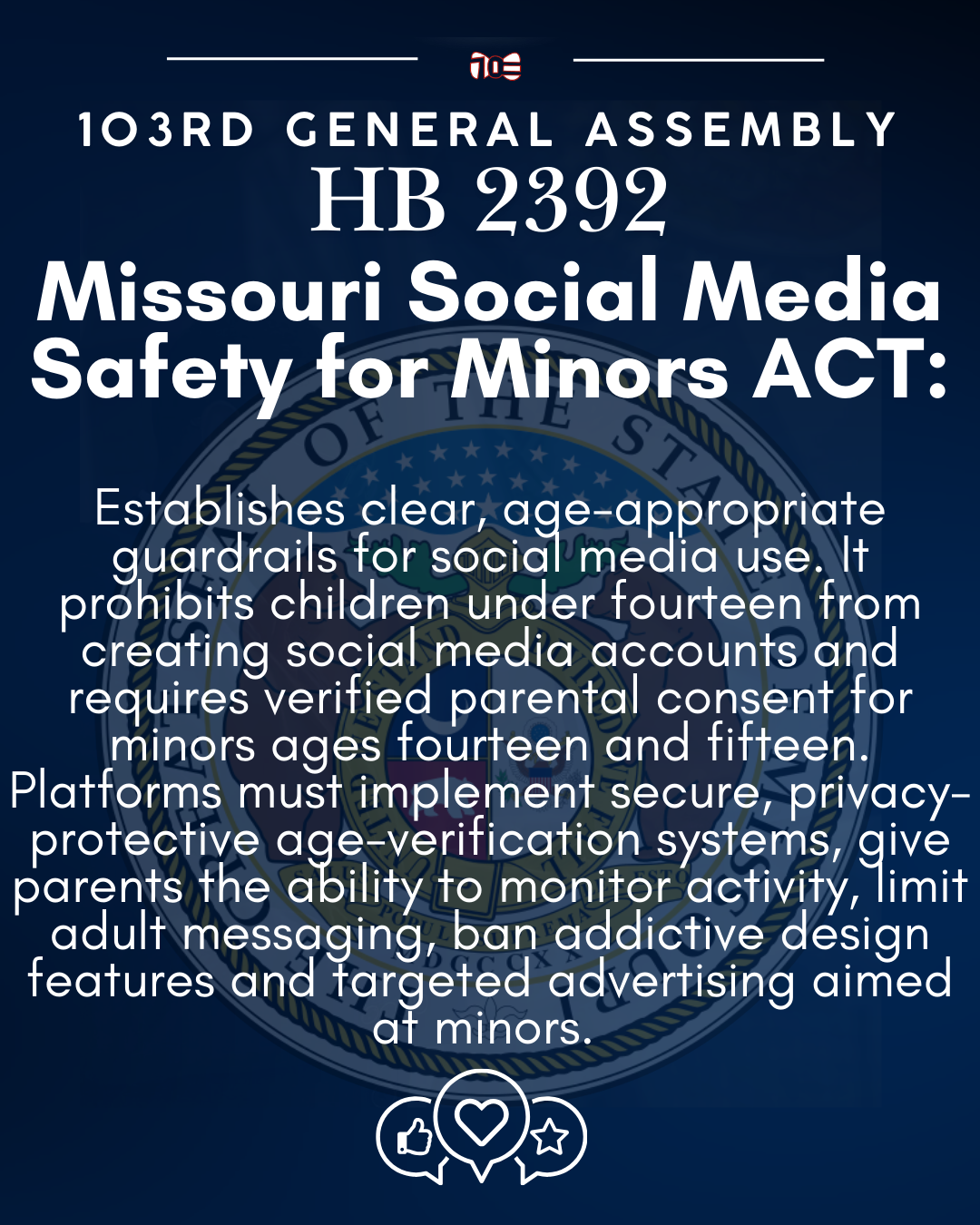
The Missouri Social Media Safety for Minors Act responds to a growing and urgent crisis facing our children: the unchecked influence of social media platforms designed to maximize engagement at the expense of young people’s mental health, safety, and development. As research highlighted in The Anxious Generation and echoed by parents, educators, and pediatric experts shows, early and unregulated exposure to social media is linked to rising rates of anxiety, depression, sleep disruption, and online exploitation among youth. This legislation recognizes that children deserve protections in digital spaces just as they do in the physical world — and that parents deserve meaningful tools to guide and safeguard their children’s online lives.
What the bill does:
The Missouri Social Media Safety for Minors Act establishes clear, age-appropriate guardrails for social media use. It prohibits children under fourteen from creating social media accounts and requires verified parental consent for minors ages fourteen and fifteen. Platforms must implement secure, privacy-protective age-verification systems, give parents the ability to monitor activity, limit adult messaging, and request account deletion, and ban addictive design features and targeted advertising aimed at minors. Companies that violate these protections are subject to enforcement by the attorney general and civil penalties, ensuring accountability for platforms that put profit ahead of children’s wellbeing.

Every day, families across Missouri unknowingly come into contact with per- and polyfluoroalkyl substances (PFAS) — a class of “forever chemicals” linked to serious health and environmental harm when they’re intentionally added to everyday products like cookware, carpets, cleaning supplies, cosmetics, and children’s items. HB 2400, also known as the Missouri PFAS Consumer Protection Act, takes decisive action to protect public health and the environment by requiring manufacturers to disclose when products contain intentionally added PFAS and by phasing out the sale of many PFAS-containing products unless the chemical use is truly unavoidable.
Under the bill, manufacturers must submit detailed information about PFAS in their products to the Department of Natural Resources before selling them in Missouri, and beginning in 2027 certain products with intentionally added PFAS — including cleaning products, cookware, textiles, cosmetics, juvenile products, and more — cannot be sold in the state. These steps help reduce toxic exposures, strengthen consumer transparency, and spur innovation toward safer alternatives. By placing accountability on producers and elevating public awareness of PFAS in common goods, this legislation prioritizes the health of children, households, and our natural resources for generations to come.

This legislation draws a clear line: poverty should never be treated as a crime. By prohibiting harmful and punitive practices that target people simply for being unhoused, this bill protects basic human dignity and establishes clear boundaries on how local governments and authorities may respond to homelessness. Like a Bill of Rights, it affirms that unhoused Missourians are entitled to safety, fairness, and humane treatment — not displacement, harassment, or criminalization. The bill shifts the state away from punishment and toward solutions that respect civil rights, promote stability, and recognize that lasting progress comes from housing and support, not bans that push people further into crisis.

Missouri faces persistent challenges with healthcare access — especially in rural and underserved areas where there simply aren’t enough providers to meet community needs. HB 2391 takes a meaningful step toward expanding access to care by allowing highly trained Advanced Practice Registered Nurses (APRNs) to practice at the full extent of their training once they have completed a set amount of supervised experience.
Under the bill, APRNs who have logged 2,000 hours of documented practice with a collaborating physician or who demonstrate equivalent experience when seeking licensure by endorsement will no longer be required to maintain a collaborative practice agreement to treat patients. The bill also expands APRNs’ authority to include the prescription of both pharmacologic and non-pharmacologic therapies — aligning their practice more closely with physician-level care and helping ensure Missourians can get the treatment they need in their communities.
By reducing unnecessary regulatory barriers for qualified nurses, this legislation increases continuity of care, helps address provider shortages, and supports more timely access to diagnosis, treatment, and management of health conditions across the state.

Infertility Awareness Week: Infertility Awareness Week shines a light on a deeply personal struggle that millions of individuals and families face but often carry in silence. By bringing visibility to infertility, this week helps break down stigma, encourages open conversations, and promotes access to medical, emotional, and financial support. It also underscores the urgent need for equitable reproductive healthcare — ensuring that every person, regardless of background or income, has a fair chance to build the family they dream of. Recognizing this week is a reminder that infertility is a public health issue, not a private failing, and that compassion, education, and policy action are essential to supporting those on their fertility journey.
Pathway to Barber Apprenticeship ACT: The Pathway to Barber Apprenticeships Act opens doors for Missourians who want to build a career, earn a living, and strengthen their communities through the art and trade of barbering. For too long, aspiring barbers. Some from low-income, rural, and marginalized backgrounds have faced costly, rigid barriers that make entry into the profession harder than it needs to be. This legislation creates a clear, affordable apprenticeship pathway that allows students to learn directly from licensed barbers while gaining real-world experience in barbershops across the state. By expanding access and reducing unnecessary hurdles, the Pathway to Barber Apprenticeships Act supports small businesses, grows the workforce, and preserves a craft that has long been a cultural anchor in Black communities and beyond. It’s an investment in opportunity, entrepreneurship, and the next generation of Missouri barbers.
Quinton’s Law / Hayes ACT: Students are facing rising academic pressure, higher stress, and growing mental-health needs.Our schools must adapt. Middle schoolers, in particular, sit at the critical intersection of adolescence and increasing school demands, yet Missouri provides no statewide guarantee that they receive the structured movement, rest, or reset time proven to improve focus, behavior, and overall well-being. Quinton’s Law changes that by requiring daily recess and brain breaks for grades 6–8 and allowing elementary schools to continue doing what is developmentally essential: giving kids time to breathe, move, reset, and learn more effectively. Quinton’s Law requires all Missouri public schools serving grades K–8 to provide students regular recess (for K–8, adapted appropriately for older grades) and at least two daily “brain breaks,” beginning in the 2027–2028 school year. Districts cannot withhold these breaks as discipline, DESE receives rulemaking authority to guide implementation, and grants may be provided to help schools adopt these practices. The bill builds on existing statute rather than repealing it, ensuring consistency and clarity.
No child should go hungry at school because good nutrition isn’t a luxury, it’s a foundation for learning, growth, and opportunity. The Hayes Act is a step toward making that ideal real. By ensuring that students who qualify for reduced-price lunches always receive a free lunch at school, this bill helps eliminate the stigma, uncertainty, and missed meals that too many families face. It supports learning, levels the playing field for children from lower-income households, and strengthens communities by guaranteeing that our schools meet basic needs, not just academic standards. The Hayes Act requires any public or participating charter/private school to provide a free lunch to every student approved for a reduced-price lunch under the federal program. The state establishes a dedicated “School Meals Fund” to reimburse schools for the difference between the actual lunch cost and federal reimbursement, ensuring no school — or student — is left paying the price. The bill also ensures confidentiality, prohibits public labeling or stigmatizing students who receive free meals, and requires schools to assist parents in applying for the benefit.
Missouri Social Media Safety for Minors ACT: Social media can connect; it can also endanger. The explosion of screen-based childhood has contributed to an unprecedented mental-health crisis among youth, with rising rates of depression, anxiety, self-harm, and disrupted development tied to social media overuse, social comparison, and sleep disturbance. The Missouri Social Media Safety for Minors Act would put common-sense protections around minors’ use of online platforms: establishing age-appropriate guardrails, requiring transparent safety standards, limiting design features that exploit young users’ vulnerabilities, and giving parents and the state tools to safeguard children’s digital well being. By prioritizing the mental health and development of children over the profits of technology companies, this bill affirms that Missouri values real-world connection, healthy growth, and safe childhoods; not endless scrolling, algorithmic addiction, and premature exposure.
 Marty Joe Murray, Jr