
During the month of October and November I toured every neighborhood association in the district to provide the following updates.


The Missouri General Assembly meets each year from January to mid-May, and during that time every bill must travel a long, structured path before becoming law. Bills are first filed and assigned to committee, where they receive hearings and can be amended before moving to the full House for debate and a vote. If passed, the bill then heads to the Senate to repeat the same process, and only after both chambers agree on identical language is a bill considered “truly agreed and finally passed.” Even then, the Governor may sign, veto, or allow the bill to become law without a signature. In September, lawmakers return for veto session, where the legislature can attempt to override any vetoes. This year alone, 1,713 bills were filed in the Missouri House and Senate, but only 39 made it all the way through the full process;showing just how rigorous and selective our lawmaking system truly is.

The Missouri House’s official website, House.mo.gov, is the best place for the public to stay informed about the legislative process. Visitors can look up every bill filed in the House, track its progress, read full bill texts, and review all related hearing notices and committee information. The site also provides easy access to my sponsored and co-sponsored legislation, allowing you to see exactly what I’m working on throughout the session. In addition, you’ll find the press releases I’ve issued, which offer updates on key issues, district news, and major legislative developments; all in one convenient and transparent location.

On house.mo.gov, each bill has its own detailed page that helps the public understand exactly what the legislation does and where it is in the process. The Bill Text section shows the full legal language of the proposal, including any versions that change as the bill moves through committees or floor debates. The Bill Summary offers a plain-language explanation of what the bill aims to accomplish, making it easier to understand without reading the full statutory text. The Action tab provides a chronological list of every step taken on the bill when it was filed, referred to committee, heard in public testimony, amended, voted on, or sent to the opposite chamber so anyone can follow its progress from start to finish.

HB 495 (2025): This bill modifies several public-safety provisions in the state. Among its key changes: it requires candidates for the office of sheriff in St. Louis City to hold a valid peace-officer license within two years of election. It also mandates that starting January 1, 2027, law enforcement agencies in St. Louis City must submit referrals of traffic, ordinance, and criminal violations to prosecuting or circuit attorneys, with felony referrals including probable-cause statements and investigative reports. Failure to comply can mean those agencies lose eligibility for certain state or federal criminal justice funding.
HB 567 (2025): This legislation deals with employee compensation and labor mandates. The bill repeals the statewide paid-sick-leave statute that had been approved by voters, and it removes future cost-of-living-based increases in the minimum wage beyond the scheduled rise to $15/hour in 2026. The repeal becomes effective August 28, 2025.
SB 4 (2025): This is a broad utility-regulation bill. It modifies existing laws and adds new provisions governing public utilities in Missouri — for example, increasing penalties for certain violations of federal natural-gas safety standards, changing oversight of HVAC service violations, and reallocating how regulatory expenses are distributed among utility-groups. Critics say it will raise utility rates and reduce consumer protections.
HJR 73 (2025): This joint resolution proposes a constitutional amendment relating to reproductive health care, to be placed on the ballot for voter approval. If adopted, it would repeal the existing “Right to Reproductive Freedom Initiative” and authorize the legislature to restrict abortion beyond current limits. It also prohibits public funds for certain abortions, bans gender-transition surgeries/hormones for minors, and sets additional restrictions around abortions based on prenatal diagnosis of disability.
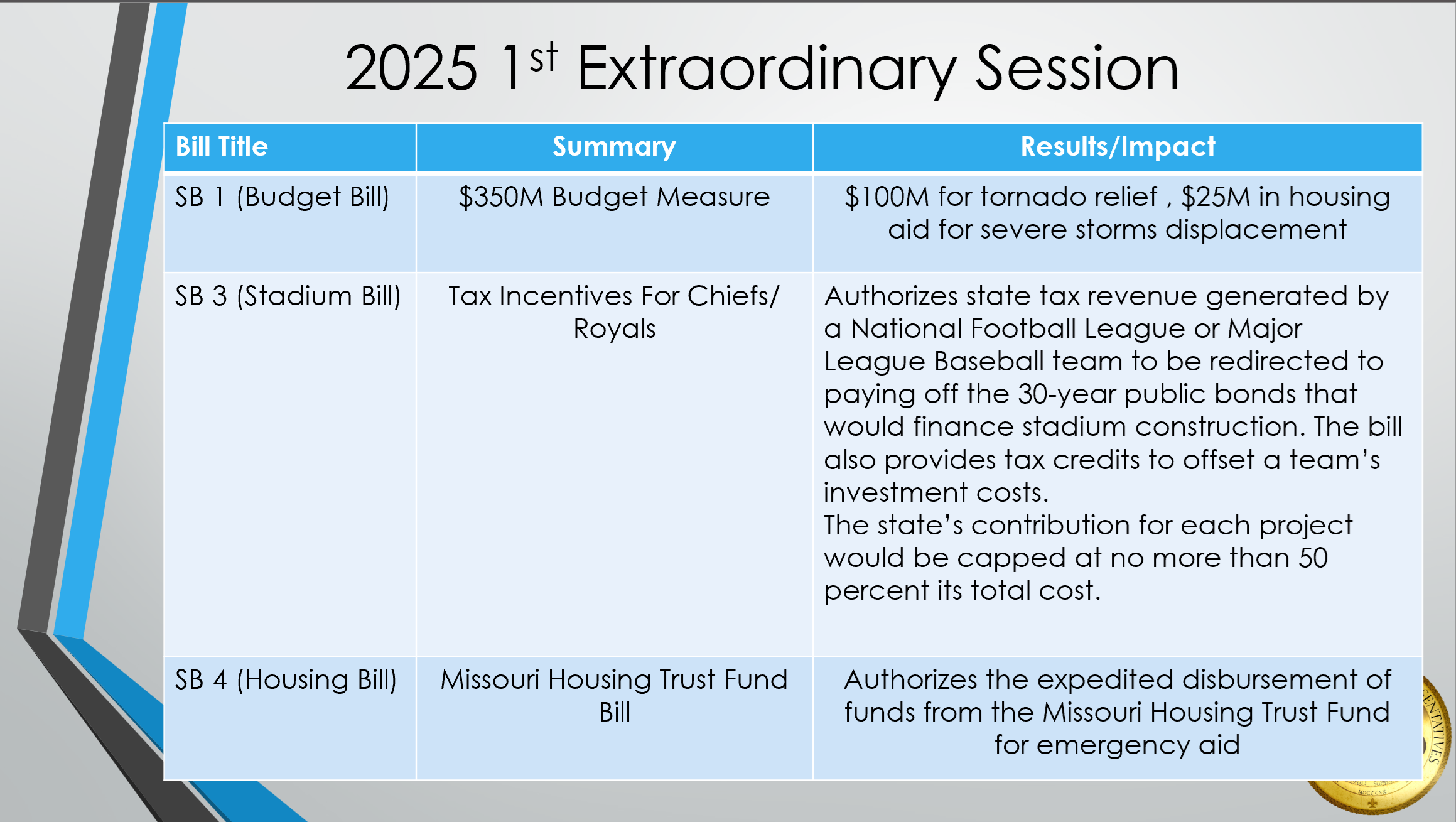
Senate Bill 1 (2025): This bill appropriates significant funds for state priorities: affordable housing aid via the Missouri Housing Development Commission, construction of the University of Missouri Research Reactor (MURR) Radioisotope Science Center, emergency disaster-relief support, capital improvements for state parks, National Guard facilities, the Missouri State Fair, and more.
Senate Bill 3(2025): This legislation addresses taxation and economic development through the “Show-Me Sports Investment Act,” which supports professional sports facility projects and offers tax credits for disaster-affected homeowners. It also includes a major property-tax question for many counties dividing them into “zero-percent” and “five-percent” annual increase zones. Missouri Senate+2blog.umb.com+2
Senate Bill 4 (2025): This bill improves access to emergency housing aid by authorizing expedited disbursement of funds from the Missouri Housing Trust Fund and raising eligibility income caps to expand who can receive assistance in the wake of disaster.
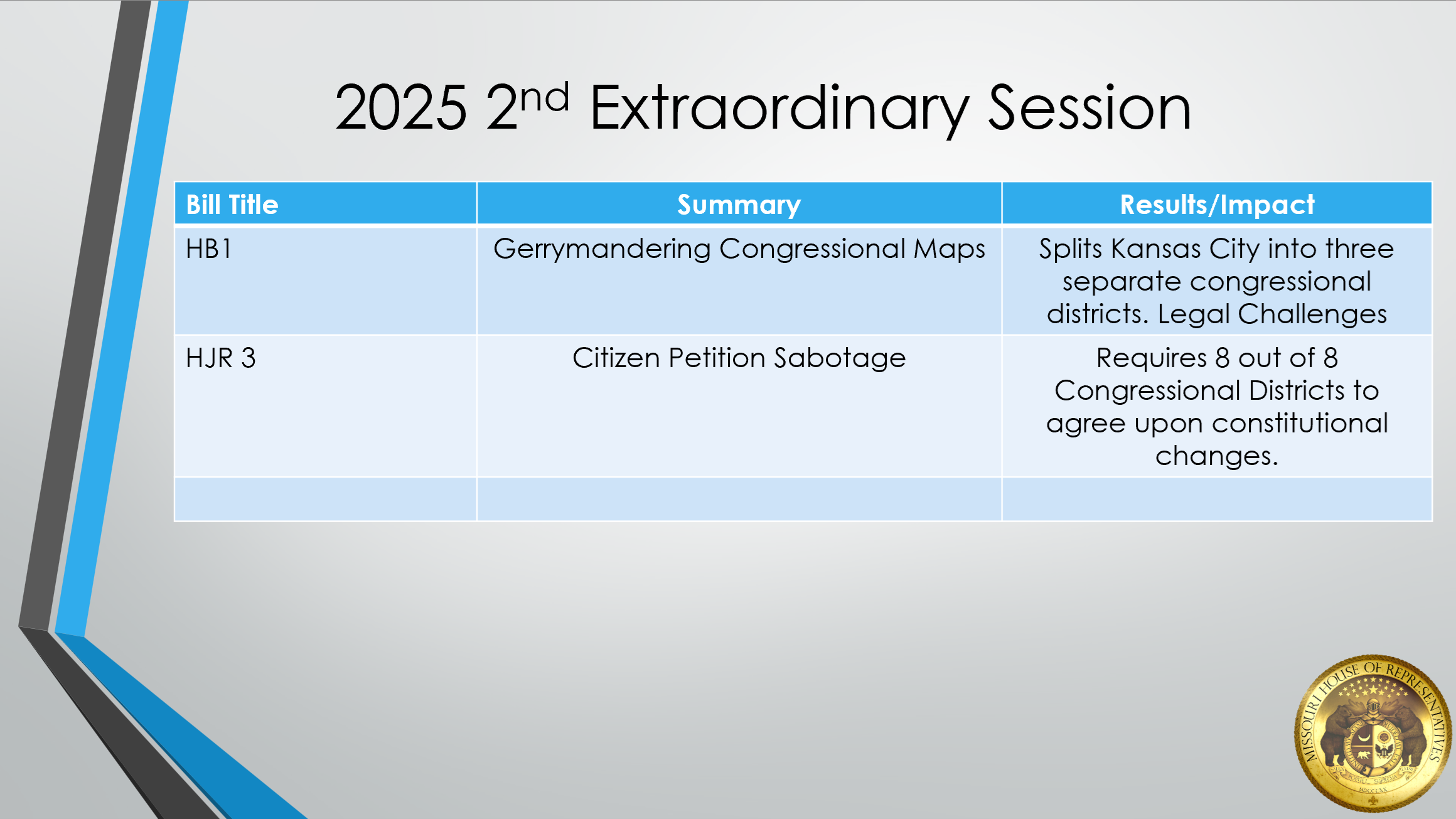
HB 1(2025): redrew Missouri’s congressional districts in a way that many critics—including me—believe undermines fair representation. The proposal, pushed through during a rushed special session, reduced community input and created a map that favors partisan outcomes rather than reflecting the real makeup of Missouri’s population. I voted against HB 1 because Missouri families deserve congressional districts drawn through a transparent, accountable, and non-partisan process—not one designed to lock in political advantage.
HJR 3(2025): was a direct attempt to make it harder for Missourians to use the initiative petition process, one of the last tools everyday people have to check legislative power. By requiring a majority statewide and a majority in every congressional district, this proposal would allow a minority of voters to block the will of the majority. I voted against HJR 3 because it silences rural and urban Missourians alike, weakens direct democracy, and shifts power away from the people and toward political insiders.

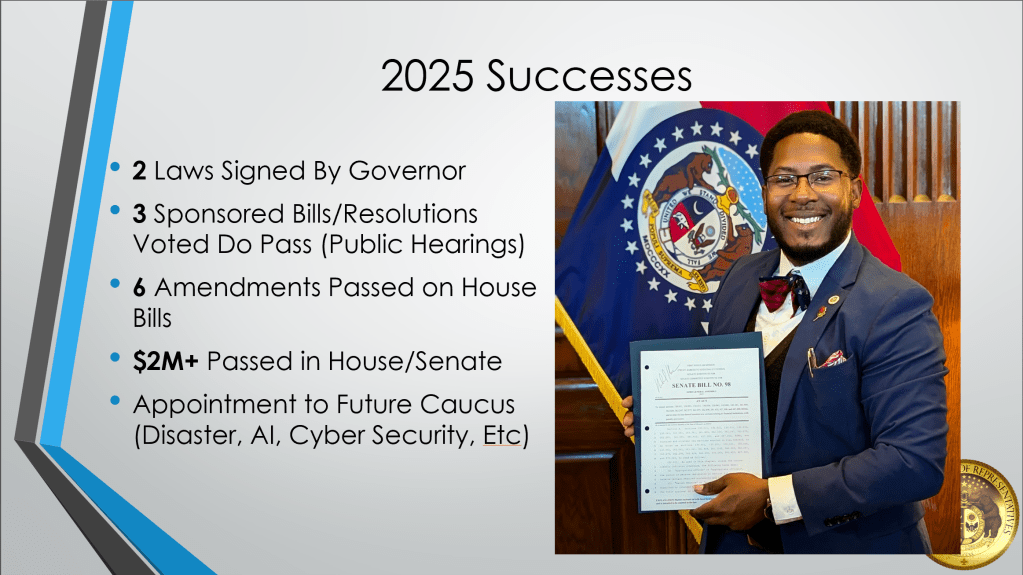
Despite serving in a super-minority caucus, I achieved meaningful progress this year. I passed more amendments than any other Democrat this session, ensuring that important priorities were reflected in the final legislation. I also secured $2 million in the state budget for critical community investments, and while the Governor ultimately vetoed nearly those funds, the effort underscored my commitment to advocating for my district. In addition, three of the bills I personally sponsored received full public hearings;an important step in elevating key issues and driving them into the legislative conversation. My work continued beyond session as well, including my summer and fall appointment to the Future Caucus, where I have been advancing bipartisan, forward-looking solutions for Missouri’s next generation.
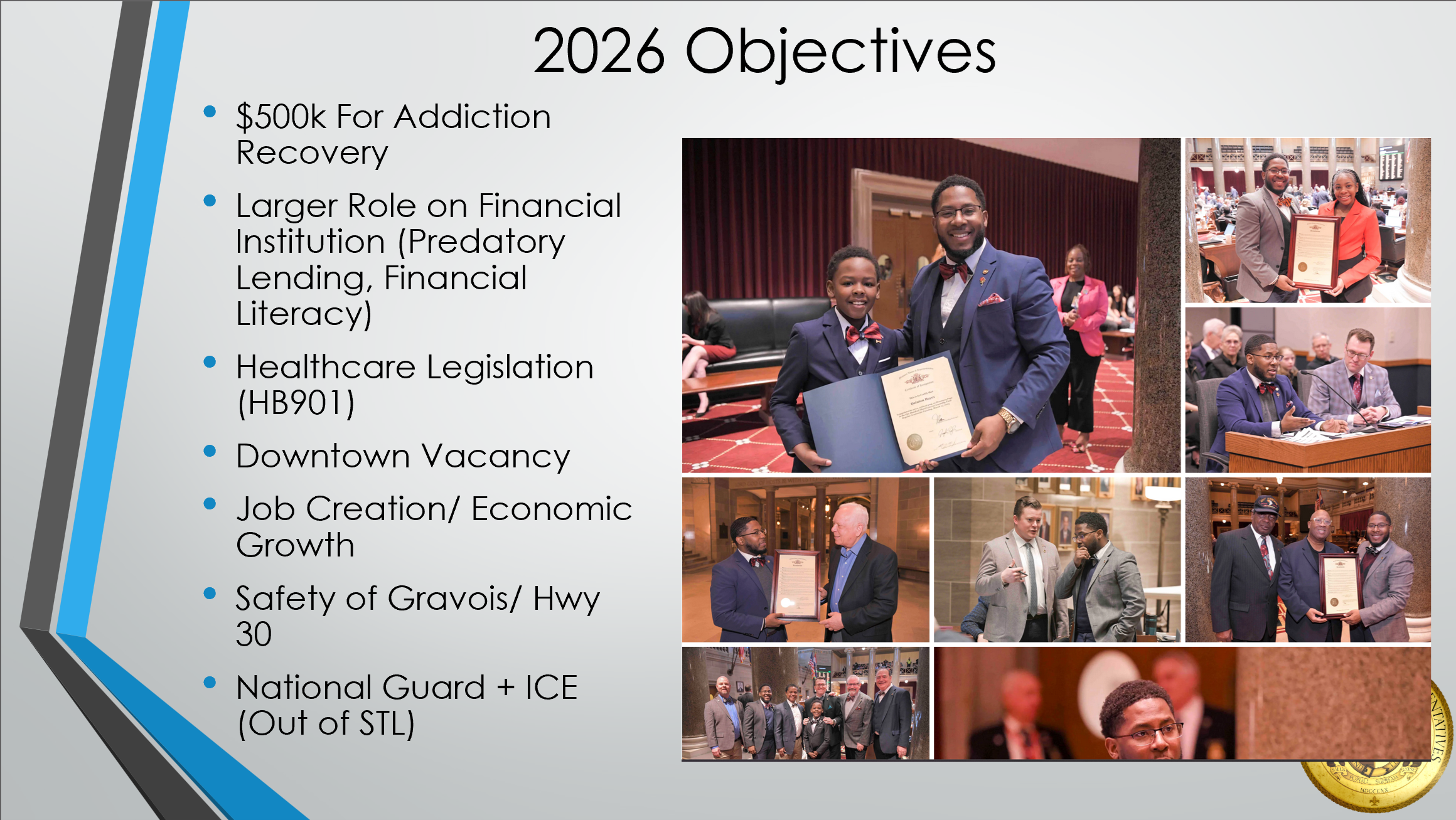
In 2026, my work will focus on delivering concrete solutions to some of the most urgent challenges facing St. Louis and the state. I will be pushing to restore the $500,000 in funding that was vetoed; critical resources needed to confront the drug epidemic impacting families across our community. I also plan to expand my leadership on financial institutions by championing legislation to curb predatory lending and strengthen financial literacy statewide. Building on the momentum of this year, I will continue advancing HB 901, reintroduce my downtown revitalization bill, and work closely with MoDOT to accelerate safety improvements along key corridors. In addition, I am actively examining the extent of cooperation between the National Guard and ICE to ensure transparency and accountability in state/federal interactions. Together, these priorities reflect my commitment to public safety, economic fairness, and a stronger future for St. Louis.

The project covers a 5.7-mile stretch of Route 30 (Gravois Avenue) in St. Louis City. Its an active corridor where folks live, work, shop, walk, bike and take transit. The road has had a disproportionate share of serious crashes: between 2020 and 2024 there were 22 fatalities (8 pedestrians), 77 serious injuries (16 pedestrians), and 871 minor injuries (31 pedestrians, 5 cyclists), which is about four times the crash rate of comparable roadways in Missouri. Missouri Department of Transportation
Though Gravois is city-owned, MoDOT maintains the pavement, signage, striping and signals “from curb to curb,” while the City handles sidewalks, lighting, drainage and other infrastructure; the two jurisdictions will coordinate improvements. Missouri Department of Transportation
Work includes a full corridor study beginning in October 2025 that will run through late 2027, with three public meetings scheduled between February and November 2026 to collect input from residents, businesses, and users of the corridor. Following that, design will proceed toward a construction start expected in fall 2029. Missouri Department of Transportation
In the meantime, MoDOT has already implemented safety enhancements along the corridor: automatic bike detection at a key intersection, leading pedestrian intervals at signals, reflective backplates, enhanced crosswalk markings, and bump-out islands to reduce pedestrian exposure to traffic. Missouri Department of Transportation

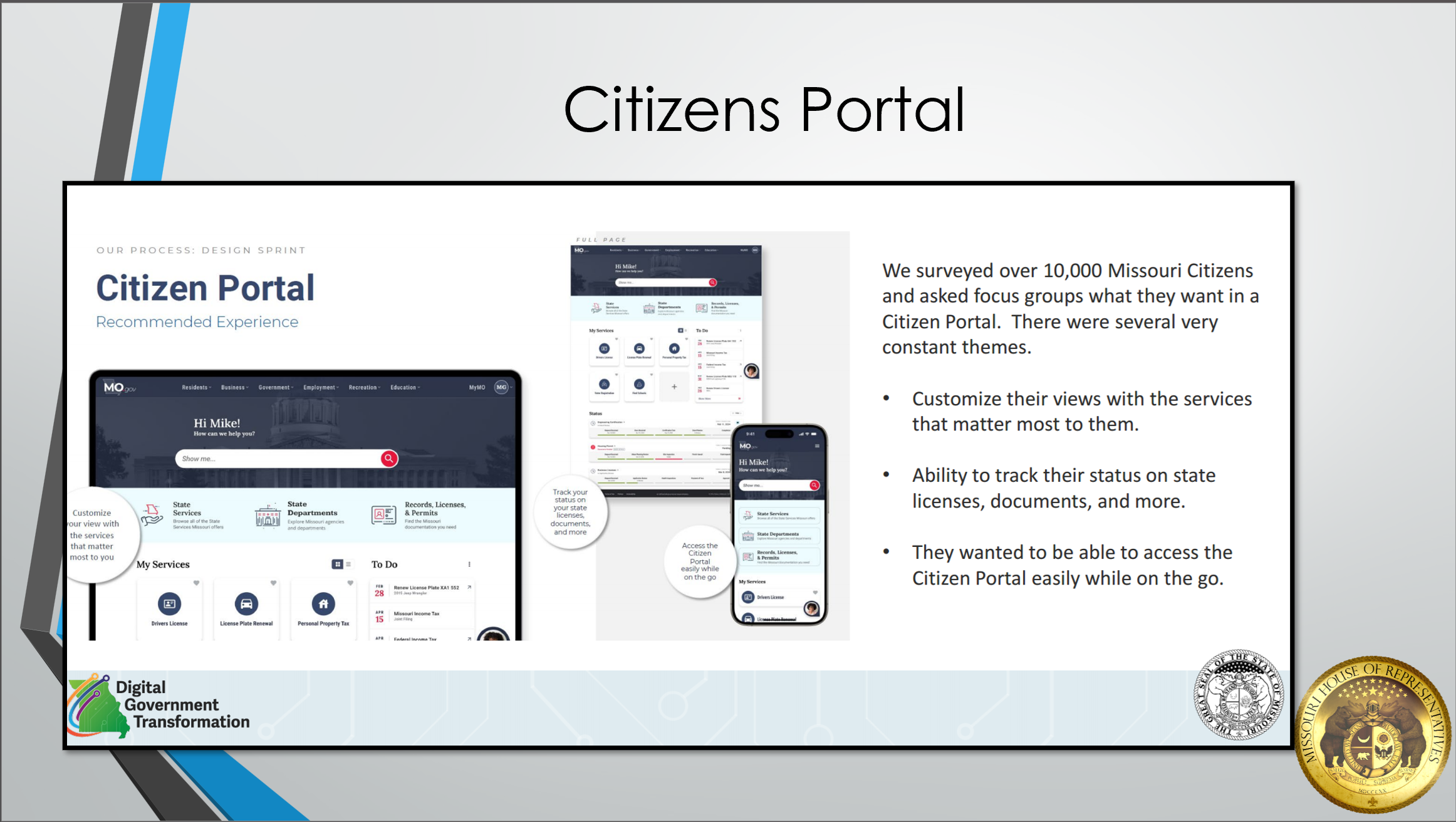
The my.mo.gov citizen portal is Missouri’s new streamlined gateway to state government. It was built to save residents time, reduce confusion, and make essential services easier to access. With one secure login, people can handle everyday needs like renewing licenses and vehicle registrations, checking tax information, applying for benefits, managing hunting and fishing permits, accessing childcare and family services, or tracking professional licensing requirements. The portal also helps users file unemployment claims, request vital records, monitor state payments, and connect with workforce and job-training programs. Instead of navigating multiple agency websites, everything is organized in one personalized dashboard where citizens can track their requests, upload documents, receive updates, and quickly return to the services they use most. For busy families, seniors, job-seekers, business owners, and anyone who wants a simpler way to interact with government, my.mo.gov makes state services faster, more transparent, and far more convenient.
 Marty Joe Murray, Jr