
Required Documents
- Photo ID (A photo of a valid State Photo ID or valid Drivers’s License)
- Proof of Income (If Applicable, Paycheck Stubs, SSI Letter Unemployment Letter, TANF, etc )
- Proof of Primary Residence (Utility Bill)
- Proof of Social Security Number( needed for City of STL Water Bill)
- Past Due Utility Bill/ Disconnect Notice
Utilities Are a Basic Right. St. Louis Can Show What That Looks Like.
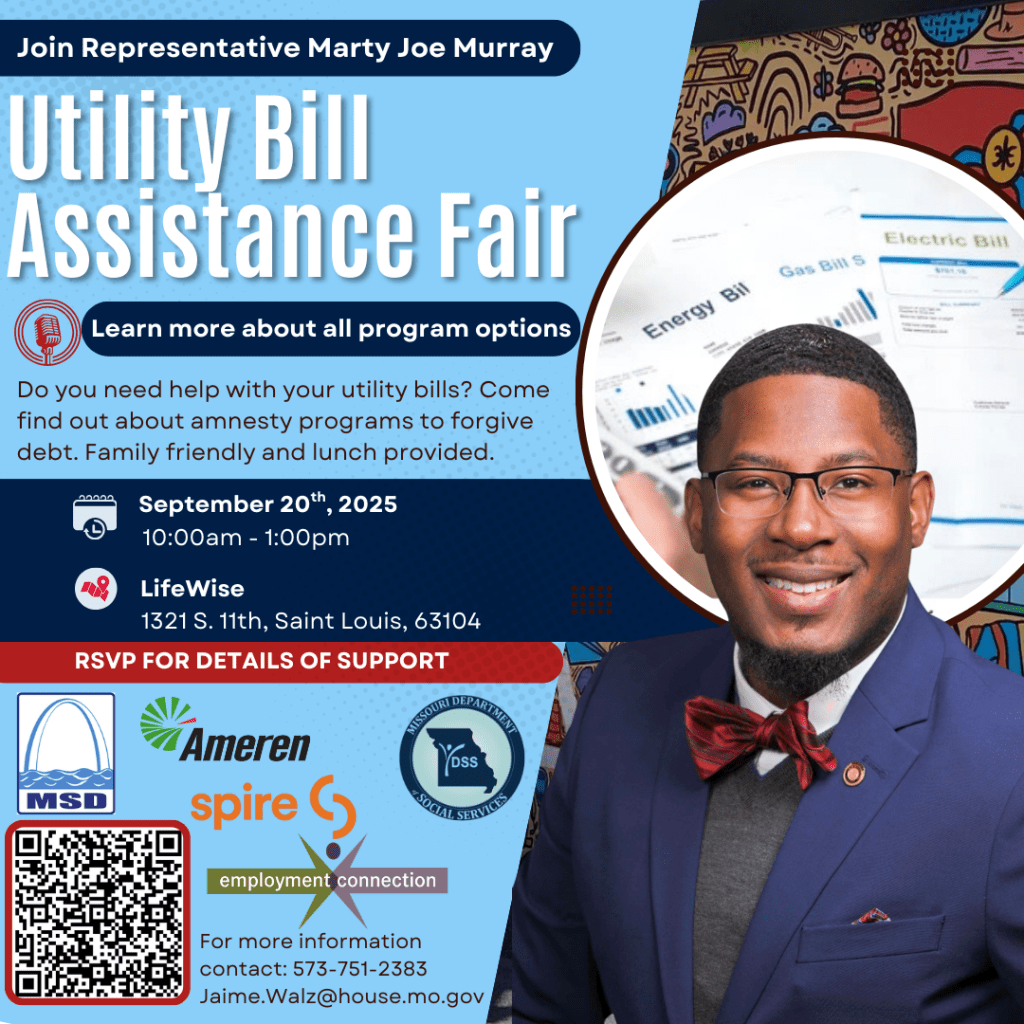
I’m inviting every member of our community to the Utility Assistance Fair because too many Missouri families are one past-due notice away from crisis. The goal is simple. Connect people to real help; on the spot. Applications. Payment plans. Emergency relief. Case management. We’re bringing the Missouri Department of Social Services’ LIHEAP team together with Ameren, Spire, the Metropolitan Sewer District, Heat Up/Cool Down St. Louis, the Urban League, Employment Connections and more. When a shutoff notice lands in your mailbox, you shouldn’t have to guess where to turn. You should be able to walk into a room and get answers. Today.
This is urgent. St. Louis City Water lifted its long-standing moratorium on shutoffs on September 1, 2025. City Hall reports more than 13,400 past-due residential accounts, about $12.6 million in arrears, after years of deficit operations to keep water flowing through COVID and recovery. The City created a Water Utility Assistance Program with one-time credits and repayment options, but the bottom line is clear: disconnections are back unless you’re inside the tornado impact zone. stlouis-mo.gov
Electric is no better. After a limited pause for tornado-impacted neighborhoods, Ameren resumed shutoffs in early August. The spike was immediate. According to data filed with the Missouri Public Service Commission and reported last week, 14,375 households were disconnected in August; nearly triple July’s total of 5,173. That surge triggered a formal response at City Hall. On September 12, the Board of Aldermen passed a resolution urging Ameren to pause disconnections through year’s end and to forgive debt for households harmed by the May 16 tornado. Ameren, for its part, has put $4 million toward bill relief and is hosting in-person assistance events September 16, 17, and 23 in the most-affected communities. Those are the right steps but they are not enough. STLPR
Natural gas service remains a lifeline heading into winter. Spire has kept in place a voluntary suspension of disconnections for tornado-impacted customers through September 2025 and offers extended payment arrangements and fee relief. I appreciate that decision. It recognizes a basic truth: you can’t rebuild your life with the lights out and the heat off. Spire Energy
Let me level with you about the policy landscape. This year the legislature enacted Senate Bill 4. The omnibus utilities bill with a few provisions I support and others I am less than thrilled with. On the positive side, SB 4 strengthened Missouri’s “hot and cold” weather rules. Previously, utilities had to hold disconnections for 24 hours when extreme temperatures were forecast. Now they must hold for 72 hours when summer highs are expected to exceed 95 degrees or the heat index tops 105, and when winter lows are forecast below 32. That matters. We lose people in extreme heat and deep cold. Giving families a wider weather window isn’t politics. It’s public health. STLPR 2KRPS
SB 4 also authorizes special residential rates or discounts for customers with high utility burden—the share of income swallowed by basic service. If implemented robustly by the Public Service Commission and our utilities, that tool can finally recognize what working families have been saying for years: affordability is not a talking point; it’s the point. Other parts of SB 4 tilt the playing field in the wrong direction. The bill green-lights “construction work in progress,” allowing utilities to charge for new plants while they’re still being built, and lets water and gas companies use “future test years” that set rates on projected costs. Supporters call it modernization. Families see it for what it will be; a bigger bill. When we ask households to front construction risk and pay based on expectations, we’re shifting costs from corporate ledgers to kitchen tables. That is not the balance Missourians deserve.
This is where I stand. Utilities are a basic human right in a modern, civilized society. That is not rhetoric. It is a commitment to health, safety, and dignity. We refrigerate insulin. We cook meals. We keep elders warm. We flush toilets and wash hands. When service is disconnected, the consequences spiral: spoiled food, medical instability, eviction risk, unsafe housing, child welfare concerns. The price gets paid somewhere. It’s cheaper and more humane to keep people connected.
So here’s what we’re doing now and what comes next.
First, the Utility Assistance Fair is designed to solve problems at the front door. If you’re behind, we will sit with you, pull your documents, and complete the application. We will work a payment plan that fits reality, not fantasy. For tornado-impacted families, we will make sure you know about fee waivers and extended arrangements. For water customers outside the impact zone, we will connect you to the City’s new assistance program and repayment plans. Nobody should leave that room in the dark about what to do next.
Second, I am pushing our state regulators and corporate partners to use every tool SB 4 provides to reduce burdens on the most vulnerable. That starts with making the 72-hour weather protections real in practice and not just on paper. We must create income-sensitive rates that actually cut bills for households with high utility burden. When we say “affordability,” it should show up on a monthly statement.
Fourth, we need transparent, public disconnection reporting that’s disaggregated enough to target help. We should not be guessing which neighborhoods are losing service. The data exists. It should be timely and granular. When we can see the problem, we can solve it faster.
Third, I fully support the Board of Aldermen’s call to pause shutoffs while recovery continues. Families are still displaced. Roofs are still tarped. Budgets are still broken. A time-limited moratorium paired with targeted debt forgiveness in tornado corridors is a reasonable, compassionate bridge from disaster to stability. We can revisit the schedule as recovery data improves. stlouis-mo.gov
Finally, we need to keep perspective. Ameren’s $4 million for bill relief is welcome. City water’s assistance program is needed. Spire’s voluntary protections for tornado-impacted residents are appreciated. None of it changes the underlying math. Wages are flat. Prices are up. And a shutoff notice doesn’t care whether you just paid for school supplies or a prescription. The only way out is through. By aligning our assistance systems, our regulatory rules, and our corporate practices with one clear north star: keep people connected.
If we do that, St. Louis can model what a modern utility policy looks like practical, compassionate, and fiscally honest. The Utility Assistance Fair is one room on one day, but it’s also a statement of values. We don’t leave neighbors behind. We get people to yes. And we keep the lights on.”
Additional Support
| Company | Address | Phone |
| Department of Social Services (LIHEAP) | https://mydss.mo.gov/utility-assistance/liheap | 1-855-373-4636 |
| City of STL Water | 1640 S. Kingshighway Blvd, 63110 https://www.stlwater.com/permits-applications/assistance-program.php | (314) 633-9000 |
| Urban League of Metropolitan St. Louis, | 1408 North Kingshighway Boulevard Saint Louis, MO 63113 | 314-615-3600 |
| Peoples Community Action Corporation North City | 4236 Lindell Avenue Third Floor Saint Louis, MO 63108 | 314-862-6270 |
| Lutheran Senior Services | 1150 Hanley Industrial Court Saint Louis, MO 63144 | 314-968-9313, 314-446-2475 |
| Guardian Angel Settlement Association Social Service Site | 3300 South Jefferson Avenue Saint Louis, MO 63118 | 314-773-9027 |
 Marty Joe Murray, Jr