
Representative Murray 1st Year Successes
Six Amendments Passed: This legislative session, I passed more amendments than any other House Democrat, demonstrating a strong commitment to thoughtful, impactful policymaking. Each amendment reflected a clear understanding of the needs of everyday Missourians and a willingness to work across the aisle to deliver results. From protecting workers and payees in payroll processing to expanding economic development tools for neighborhood organizations, my legislative work was guided by the values of accountability, fairness, and community investment.

Among the highlights of these amendments: I ensured payroll processing agents are clearly bound by written agreements and that payors remain fully responsible for payments, even if a third party mishandles funds. This change ensures protections for workers from being shortchanged. I helped expand access to tax credits for affordable housing providers, allowing up to $11 million in total support when other programs fall short, while also increasing credit rollover flexibility for businesses that invest locally. I led the effort to establish the last full week of April as “Infertility Awareness Week” in Missouri, helping to reduce stigma and support families facing reproductive challenges. Additionally, I added a requirement that all video lottery machines display visible gambling addiction warnings, promoting transparency and consumer safety.
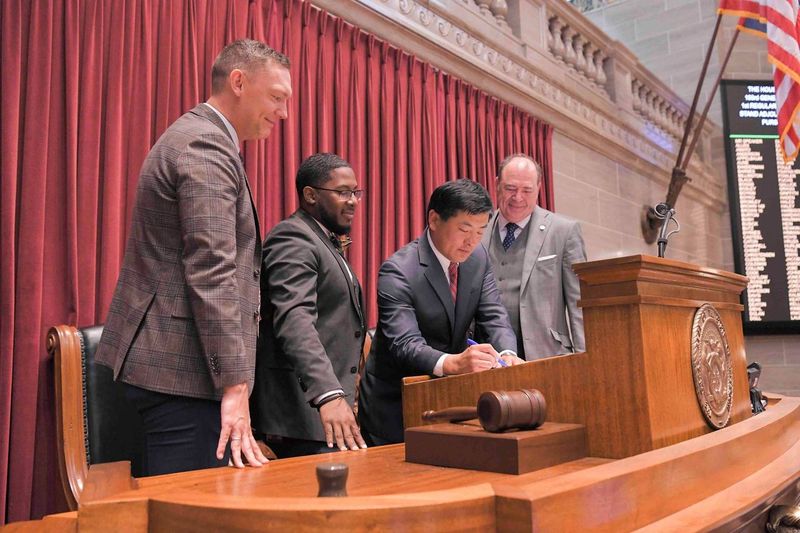
Three Hearings for Sponsored Bills: This session, I had three bills voted “do pass” out of committee. This is an essential step toward transforming ideas into law. Committee approval not only advances legislation to the next stage of the process, but also creates space for public testimony, giving everyday Missourians and advocates a direct voice in shaping policy. It’s also where bipartisan support is tested and refined, helping to build the momentum needed to bring real solutions across the finish line.

The three bills reflect a broad but connected set of priorities: revitalizing our communities, promoting public health, and supporting families. One bill creates the Revitalizing Missouri Downtowns and Main Streets Act, which offers tax credits for converting unused office space into housing and commercial use; that boost economic growth and local development. Another bill establishes Infertility Awareness Week during the last full week of April, aiming to reduce stigma, expand awareness, and uplift those facing reproductive challenges. The third bill supports the safety of health care workers by establishing the Hospital Security Fund and launching an education campaign on the consequences of assaulting medical staff—responding to the alarming rise in violence in health care settings. Each bill was informed by real-world experience, community input, and a clear vision for a stronger, safer, more inclusive Missouri.
$2 Million Advanced In the Missouri State Budget: This year, I successfully advanced $2 million in the state budget to support vital community-based organizations. Getting it there wasn’t easy. First, I had to secure support for the funding changes in the House, navigating political pushback and competing priorities. Then came the Senate, where I had to defend every dollar and build bipartisan backing to keep the investments intact. The real test came in conference committee, where I had to ensure these priorities didn’t get cut in last-minute negotiations. This funding is still contingent on the Governor not using his line-item veto power to strike it from the final budget. The organizations receiving these funds are doing life-saving, community-rooted work. Doorways supports people living with HIV; Viking Advantage and Ritenour Food Pantry help feed families in need; the Doula Online Registry expands access to maternal care; All Hands on Deck fights food insecurity through community food sharing; and LIV Recovery Services helps individuals transition from substance use disorder into stable, healthy lives. These are the kinds of investments that transform lives and I’ll keep fighting to make sure they stay in the budget.
| House Bill | Company | House | Senate | Conference |
| HCS 10.115 | Doorways | $500,000 | $750,000 | $500.000 (10.115) |
| HCS 3.206 | Viking Advantage | $100,000 | ($100,000) | $100,000 |
| HCS 6.023 | Ritenour Food Pantry | $60,000 | ($60,000) | $60,000 |
| HCS 10.780 | Doula Registry | $100,000 | $100,000 | $100,000 |
| HCS 11.291 | All Hands on Deck | $250,000 | ($250,000) | $250,000 |
| HCSP 8.066 | LIV Recovery Services | $250,000 | $500,000 | $500,000 |
| SCS HCS 7.020 | Gateway Arch Park | $500,000 | $500,000 | |
| HCS 19.281 | Places For People | $750,000 | $750,000 | ($750,000) |
| Total | $2,010,000 | $2,600,000 | $2,010,000 |
Upcoming Events
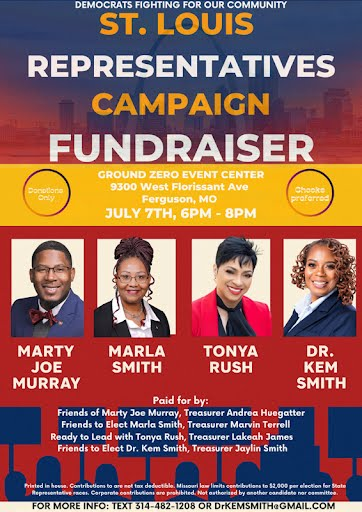
The legislature has officially adjourned until next year, and now that I’m back home, I’m hitting the ground running with several events planned throughout the district. I’ll be attending neighborhood meetings to give legislative updates, hear from constituents, and stay connected to the issues that matter most to our communities. I also have a campaign fundraiser coming up on July 7th, which will help us continue building momentum for the work ahead. Then, on August 7th, I’ll be hosting a Legislative Town Hall where folks can learn more about what happened this session, ask questions, and share their priorities for the future. I look forward to seeing you out in the community.
State Supreme Court Procedural Move puts Abortion on Hold
Abortion procedures are indefinitely on hold in Missouri after the state Supreme Court on May 27 ordered a lower-court judge to lift – at least for now – preliminary injunctions she had issued blocking enforcement of various laws restricting abortion access after Missouri voters ratified a state constitutional amendment in November protecting reproductive rights.
In a brief order signed by Chief Justice Mary Russell, the high court said the legal standard the judge relied on in issuing the injunctions is no longer controlling precedent since the 8th U.S. Circuit Court of Appeals subsequently set a higher bar for blocking state laws. Under the current standard, a party must prove they will suffer “irreparable harm” if a challenged law isn’t blocked while their case is being litigated.
The court ordered Jackson County Circuit Judge Jerri Zhang to apply the higher legal standard when re-evaluating whether blocking enforcement of Missouri’s abortion restrictions is appropriate while the case proceeds. Zhang lifted her previous injunctions May 28 but could reimpose them if she determines they are still warranted. As of June 5, however, she hadn’t yet ruled on that question.
In response, Planned Parenthood clinics in Missouri suspended performing abortions pending further action by Zhang. If she does again block the state’s abortion restrictions, Missouri Attorney General Andrew Bailey, a Republican and staunch abortion rights opponent, is expected to appeal her ruling to the state Supreme Court, just as he did with the earlier injunctions.
The Missouri Constitution now guarantees the right to an abortion up to the point of fetal viability – usually around 24 weeks of pregnancy – and later if a medical professional deems an abortion necessary to “protect the life or physical or mental health of the pregnant person.” It prohibits any person from being “penalized, prosecuted, or otherwise subjected to adverse action” for exercising their reproductive rights or helping others do so.
Weeks after the new protections took effect, Zhang issued an injunction on Dec. 20 blocking enforcement of a state law banning abortion in nearly all circumstances, along with several other statutes imposing various restrictions on access to reproductive care. She issued a follow-up ruling on Feb. 14 to also block onerous licensing requirements that applied to abortion clinics but not other outpatient health care providers.
The case challenging the injunctions is State ex rel. Mike Kehoe v. The Honorable Jerri Zhang. The underlying case is Comprehensive Health of Planned Parenthood Great Plains v. State of Missouri.
Peaceful Protests Proves False Kehoe’s Claim of ‘Civil Unrest’
“No Kings Day of Defiance” rallies took place in about 30 Missouri cities and towns on June 14 as thousands of people peacefully protested the increasingly authoritarian actions of President Donald Trump’s administration. Two days earlier, Gov. Mike Kehoe, a Republican, preemptively declared a statewide state of emergency and activated the National Guard to respond to the protests, prompting Democratic lawmakers to criticize the threatened military action as an attempt to intimidate Missourians and suppress dissent.
Kehoe’s executive order calling out the National Guard says he did “hereby declare that a State of Emergency exists in the State of Missouri due to civil unrest.” That claim was false, however, since there was no civil unrest at the time he issued the order, and none occurred later as the protests unfolded without incident. Despite the absence of any actual emergency, the governor’s state of emergency declaration remains in effect until June 30.
Democrats accused Kehoe of emulating the strong-arm tactics of Trump, who deployed the military to respond to protests in Los Angeles against his policies, actions a federal district judge ruled illegal in a fiery written opinion issued June 16, although the 9th U.S. Circuit Court of Appeals has temporarily paused that decision pending its review.
Democrats also noted that while it took Kehoe almost two weeks to deploy the National Guard to St. Louis city to assist with cleanup and recovery operations following the May 16 tornado that devastated the city’s north side, Kehoe was poised to send in troops to suppress anti-Trump protests without evidence the rallies would be anything but peaceful.
“Governor Kehoe should staunchly defend the rights of Missourians, not mimic the authoritarianism of the president,” House Minority Leader Ashley Aune, D-Kansas City, said in a statement.
Governor Signs into Law all Three Special Session Bills
Gov. Mike Kehoe on June 14 signed into law all three bills the Missouri General Assembly passed during the recent special session, authorizing taxpayer subsidies for stadiums for the Kansas City Chiefs and Royals, appropriating $100 million in aid for victims of the recent tornado in St. Louis city and relaxing eligibility requirements for qualifying for state housing assistance after disasters.
The stadium measure, Senate Bill 3, was the primary reason Kehoe, a Republican, called the session. It authorizes state tax revenue generated by a National Football League or Major League Baseball team to be redirected to paying off the 30-year public bonds that would finance stadium construction. The bill also provides tax credits to offset a team’s investment costs.
The state’s contribution for each project would be capped at no more than 50 percent its total cost. If a team relocated to another state before its stadium bonds were paid off, the team would be required to reimburse the state for all prior taxpayer investments while assuming responsibility for the remaining bond debt.
Overall, the legislation could cost the state as much as $1.5 billion over three decades for both Kansas City projects. The Royals plan to build a new baseball stadium while the NFL’s Chief have indicated a desire to renovate and expand the existing Arrowhead Stadium. However, the costs to taxpayers could be much higher if baseball’s St. Louis Cardinals also take advantage of it later to help finance renovations of Busch Stadium.
In addition to the stadium provisions, SB 3 renews an existing state tax credit for encouraging major amateur sporting events, such a NCAA tournaments, to be held in Missouri and provides disaster victims with a tax credit of up to $5,000 to help pay insurance deductibles for storm-damaged homes.
SB 3 also contains controversial provisions requiring most Missouri counties to hold public votes on whether to restrict future growth in local residential property taxes, thus limiting revenue for public school districts, municipalities and other local governments that rely on property taxes. Pending voter approval, the bill would cap growth at 5 percent in 56 counties but freeze growth at zero percent in another 22 counties. Sixteen counties – including Boone, Clay, Greene, Jackson and St. Louis – plus St. Louis city are exempt from the property tax cap votes. However, the property tax provisions are highly vulnerable to being struck down if challenged in court due to several possible violations of the state constitution.
Senate Bill 1, which Kehoe also signed into law, is a $350.56 million budget measure providing funding for capital improvement projects throughout the state. In addition to the $100 million in relief for St. Louis tornado victims, SB 1 provides another $25 million in housing aid for those displaced by the tornado and other severe storms this spring that caused damage in 37 Missouri counties.
SB 1 also provides $55 million in spending authority for new stalling barns at the Missouri State Fairgrounds, $50 million for construction of the Radioisotope Science Center at the University of Missouri-Columbia Research Reactor and $48.1 million for a new mental health hospital in the Kansas City area, among numerous other smaller projects.
The remaining special session measure to become law is Senate Bill 4, which loosens eligibility rules for storm victims to qualify for housing aid, including the $25 million provided in SB 1.

Senate Closes Debate to Send Abortion Rights Repeal to Ballot
The Missouri Senate on May 14 cleared a proposed constitutional amendment for the statewide ballot to completely repeal existing protections for reproductive rights and instead impose a sweeping abortion ban. And the deceptive ballot language Republican lawmakers crafted for it doesn’t inform voters of any of that.
After invoking a procedural move that’s uncommon in the Senate to end a Democratic filibuster, the Republican-controlled chamber voted 21-11 to send the measure, House Joint 73, to voters. By default it will go on the November 2026 ballot unless Gov. Mike Kehoe, a Republican, exercises his constitutional authority to call an earlier election date. The House of Representatives approved HJR 73 nearly a month ago.
Repealing Amendment 3, which Missouri voters just ratified in November, was a top GOP priority this year. Under the current constitutional language, abortion rights are protected up to the point of fetal viability – usually around 24 weeks of pregnancy. Legal restrictions are allowed after that point, except when a medical professional deems an abortion necessary to “protect the life or physical or mental health of the pregnant person.”
HJR 73 broadly bans abortion, with narrow exceptions for ill-defined “medical emergencies” and cases of rape or incest. However, abortions involving the latter two categories are only allowed during the first 12 weeks of gestation.
Despite deleting Amendment 3 from the Missouri Constitution in its entirety, including protections for access to contraception and other forms of reproductive care, the ballot language for HJR 73 entirely omits that fact and instead falsely claims it would “guarantee access to care for medical emergencies, ectopic pregnancies and miscarriages,” which is already guaranteed by Amendment 3.
The ballot language also says it would “protect children from gender transition,” referring to a
provision of HJR 73 that would constitutionally prohibit gender-affirming care for minors. That provision is unrelated to the measure’s primary purpose of eliminating abortion rights but was added as so-called “ballot candy” intended to appeal to voters. The ballot language is expected to face a court challenge.
The decision to cut off debate on HJR 73 and another bill to eliminate earned sick leave requirements in state law prompted the Senate to adjourn for the year two days before session was scheduled to end pursuant to the state constitution. With the Senate gone, the House spent one more day passing bills before also calling it quits early. This marks the first time in memory that neither chamber was in session for what should have been the last day.
Earned sick leave could go back on statewide ballot in 2026
Just as Democratic state lawmakers predicted, the group that successfully won passage of a ballot measure last year requiring most employers to provide earned sick leave to their workers is already moving to place the issue back on the ballot as a constitutional amendment now that the Republican-controlled General Assembly has voted to repeal the original statutory version.
Jobs With Justice spearheaded the initiative petition drive that put Proposition A on the statewide ballot in November 2024. Voters approved the measure with nearly 58 percent support. In addition to the earned sick leave requirement, Proposition A also calls for raising the standard state minimum wage to $15 an hour as of Jan. 1, 2026.
As a statute, however, Proposition A was vulnerable to legislative repeal, and Republican lawmakers made eliminating the sick leave law a top priority during the 2025 legislative session. The Senate took the final vote to send the repeal measure, House Bill 567, to the governor on May 14, with Democrats in unanimous opposition. Gov. Mike Kehoe, a Republican, championed overruling voters on this issue and is expected to sign the bill into law.
Although it repeals the sick leave provisions, HB 567 leaves the pending $15 minimum wage intact. However, it does eliminate an annual inflationary adjustment to the state wage floor that has been in state law since 2006 and also was voter approved.
But in politics as in physics, each action has an oppositive reaction, and one day after HB 567 won final passage, Jobs With Justice filed a new initiative petition to put the sick leave issue back before voters in November 2026, but this time a constitutional amendment that lawmakers couldn’t unilaterally repeal or modify without voter approval. In addition to restoring the sick leave requirements, the measure also would constitutionally protect the $15-an-hour minimum wage and reinstate the annual inflationary adjustment.
To put the sick leave amendment on next year’s ballot, the group will have to gather signatures from more than 170,000 registered Missouri voters by early May 2026. However, given Jobs With Justice’s track record with Proposition A and the popularity of that measure, it appears to be in a good position to collect the requisite number of signatures.
Lawmakers Approve 50-percent Increase in License Fee
The service fee for renewing a driver’s license or vehicle license plates would increase 50 percent under legislation the Missouri House of Representatives sent to the governor on May 15 by a vote of 131-18, with one lawmaker voting “present.” The Senate previously voted 22-11 in favor of the measure.
Under Senate Bill 3, the service fee charged by the private contractors that run the state’s license offices would rise from $12 to $18 for two-year license plates or a six-year driver’s license, effective Aug. 28. The service fee is intended to cover a contractor’s operational expenses, with excess revenue retained by the contractor as profit.
The service fee is in addition to the actual cost of the plates or license, the revenue from which goes to the state and would not change under the bill. Lawmakers doubled the fee to its current rate in 2019 after it had remained flat for about two decades.
Supporters of the increase say it’s necessary to offset recent increases in the costs of running the license offices. Opponents say imposing another large fee hike on Missouri motorists so soon after the last one isn’t justified.
 Marty Joe Murray, Jr