
103rd General Assembly Underway
The legislative session is now officially underway. House members were sworn in on January 8th and the Governor was sworn in on January 13th. During the Governor’s State of the State Kehoe laid out his vision for State. The full replay of the video can be found at House.Mo.Gov/MediaCenter.aspx. Over 1,200 bills have been filed so far; and over two hundred bills are being heard in committee. Some of the more controversial bills include control of SLMPD, Anti- DEI, Anti-LGBTQIA+, and more. You can find my full list of sponsored/ co-sponsored legislation here: https://house.mo.gov/MemberDetails.aspx?year=2025&code=R%20&district=078&category=sponsor
Committee Appointments
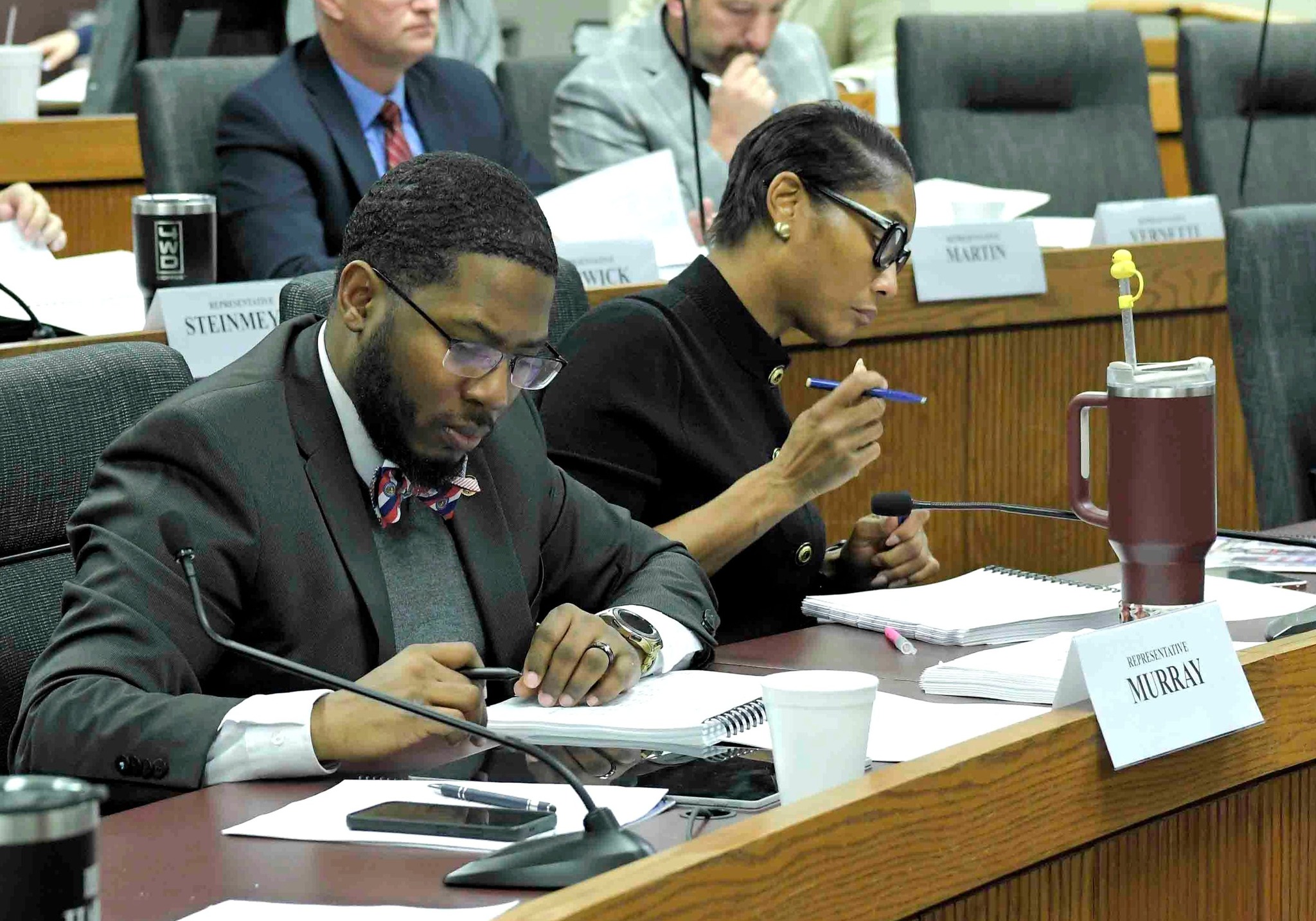
The Speaker of House has appointed me to the following committees: Budget: The Budget Committee has begun the process of going line by line to review the FY25 supplemental budget and FY26 proposed budget. In this committee I will be analyzing financial data, evaluating funding priorities, and ensuring fiscal responsibility across various sectors. I work collaboratively with other house members to develop balanced budgets. This experience has deepened my understanding of fiscal management and reinforces my capacity to drive effective, results-oriented outcomes. We have already heard from The Department of Corrections and Public Safety. Financial Institutions: Serving on the Financial Institutions Committee will consist of analyzing regulatory frameworks, financial policies, and industry trends that shape the financial services sector. Through active participation in legislative discussions and contributions to solutions for financial institutions, This experience deepens my understanding of the financial landscape of our financial institutions. Administration and Accounts: The Administration and Accounts Committee provides me with direct experience in overseeing the internal operations of the legislature, including budgetary management, resource allocation, and the implementation of administrative policies as outlined in HR 7. I will have to evaluate and approve expenditures, ensure compliance with procedural guidelines, and work to maintain accountability in legislative operations, budgeting processes, and administrative governance. Subcommittee on Appropriations – General Administration: The subcommittee is allocating funding for state administrative functions. In this committee, I analyze budget proposals, evaluate the financial needs of various state departments, and ensure resources are allocated effectively to support operational goals. By scrutinizing expenditures and engaging in discussions about fiscal priorities, I develop a nuanced understanding of public budgeting processes and financial accountability.
Restoring State Control of STL Police Again Before Legislature
Legislative committees in both the House of Representatives and Senate on Jan. 22 heard bills seeking to restore state control of the St. Louis Metropolitan Police Department. The state oversaw the department for more than 150 years until Missouri voters reinstated local authority a dozen years ago.
The state’s first takeover of the St. Louis police occurred at the outset of the Civil War as Missouri’s secessionist governor sought to limit the power of pro-Union city officials and suppress the city’s Black population, both slave and free. Although the Civil War ended, state control remained until 63.9 percent of Missouri voters approved a statewide ballot measure in November 2012 that put local officials in charge of the department.
Under both the House and Senate bills, a state-controlled board would again run the department. Although city taxpayers would continue to be responsible for funding the agency, they would have no say through their local elected representatives in how it operates. The bills also would impose fines of $1,000 per occurrence on city officials who resist state control, as well as a lifetime ban on them ever again holding elected office.
While supporters of state control say it would stem violent crime, there is no evidence it would have an impact. When the state previously controlled the St. Louis police, there were several periods when crime was far worse than it is today. In addition, crime rates in Kansas City, which has remained under state control, have been higher than those in St. Louis in recent years.

Opponents of the bill noted violent crime has increased throughout Missouri after majority Republicans repeatedly weakened the state’s gun laws over the last decade-plus. Given the racist origins of the original state takeover of the St. Louis police, the current effort is also drawing criticism since the largely white Republican legislative majority is seeking to seize a key municipal function in a city with a Black mayor and population that is roughly half Black.
The House Crime and Public Safety Committee heard House Bill 495, while the Senate Transportation, Infrastructure and Public Safety Committee considered Senate Bill 44 and Senate Bill 52. Neither committee took immediate action on the legislation before it.
Attorney General Attempts to Control Social Media Companies
Republican Missouri Attorney General Andrew Bailey issued a regulation on Jan. 16 purporting to dictate how social media companies moderate content on their platforms. However, Bailey’s effort appears to be an unconstitutional attempt to enact law under the guise of administrative rule – something he has unsuccessfully tried before – and is certain to face a legal challenge if finalized.
Under Bailey’s proposed rule, social media companies would be forced to give users a choice of what algorithm is used to determine the content they see, including requiring platforms to allow access to algorithms provided by outside parties. In a news release, Bailey said the regulation is intended to protect the free speech rights of social media users. However, a state official attempting to dictate how those platforms operate likely violates the speech free of the social media companies.
Although Bailey cites the Missouri Merchandising Practices Act – a consumer protection law traditionally used to crack down on deceptive business practices or the sale of defective products – as his legal authority for the rule, courts have thwarted his past attempts to use the law in novel ways to advance his conservative ideology. In 2023, a state judge blocked an administrative rule Bailey issued seeking to prohibit nearly all gender-affirming medical care for transgender Missourians, finding the attorney general had exceeded the power granted him under the MMPA.
Once the Secretary of State’s Office publishes Bailey’s proposed social media regulation, it will be subject to a public comment period and possible revision before a final order of rulemaking could be issued. As a result, it will be at least a couple of months before the rule could take effect.
Committee Considers Banning Diversity, Equity and Inclusion
The House Emerging Issues Committee on Jan. 22 considered legislation that seeks to ban state agencies from promoting diversity, equity and inclusion. The committee took no immediate action on the bill but is expected to advance it to the full House of Representatives for debate.
Republican supporters of House Bill 724 claim diversity, equity and inclusion programs promote preferential treatment based on race, gender or other characteristics. Democratic opponents of the measure maintain such programs are an effective way to encourage giving qualified members of historically marginalized groups fair consideration for employment and educational opportunities.
Kehoe’s Budget Shifts Money from Public to Private Schools
New Missouri Gov. Mike Kehoe proposed a state budget on Jan. 28 that would shortchange local public school districts by $300 million while providing $50 million in direct taxpayer funding for private school tuition vouchers, a plan that appears to violate a state constitutional prohibition against granting public money to private entities.
Basic state funding for local K-12 schools is distributed in accordance with a complex formula established in state law. The central feature of the formula is the “state adequacy target,” which is the amount of per-pupil funding deemed necessary under the law for students to achieve performance goals.
In his budget plan, Kehoe, a Republican who has been in office less than a month, opted not to fund the adequacy target for the upcoming fiscal year. However, Kehoe is proposing a $200 million increase in formula funding to account for costs enacted last year to bolster funding for public schools as part of a legislative deal to secure passage of an expansion of Missouri’s private school voucher program. But by not funding the adequacy target, the state will still fall $300 million short of hitting the minimum amount of K-12 funding called for under state law.
Because the Missouri Constitution prohibits lawmakers from directly granting public money to private organizations or individuals, the state’s school voucher program currently is exclusively funded by private donations. In exchange for those contributions, however, donors receive tax credits that reduce their state tax liability – and thus the amount of money coming into the state treasury.
Kehoe’s proposal to appropriate $50 million in taxpayer money for the program marks the first time the state has attempted to directly fund tuition for private K-12 schools. If lawmakers approve the funding during the budget process, it will almost certainly face a legal challenge for violating constitutional restrictions.
Overall, Kehoe proposed a $52.77 billion state operating budget for the 2026 fiscal year, which begins July 1. He announced his budget, along with his policy priorities for this year, during his first State of the State address before a joint session of the Missouri General Assembly.
While Kehoe’s plan calls for close to $2 billion more in spending than what lawmakers originally authorized last year for the FY 2025 operating budget, that spending plan underfunded Medicaid and many other programs well below anticipated costs, with many budget observers – including then-Gov. Mike Parson, a Republican – predicting lawmakers would need to pass a supplemental appropriations bill for FY 2025 that could be the largest in state history.
As anticipated, Kehoe asked lawmakers to pass a $2.12 billion supplemental spending bill to make up for underfunded costs in the original FY 2025 operating budget. When factoring in the massive supplemental bill, Kehoe’s FY 2026 budget proposal would keep spending roughly flat over FY 2025 levels. Kehoe also requested another $954.5 million for one-time capital improvement projects in FY 2026.
The day after Kehoe presented his plan, the House of Representatives began hearings to review his spending requests. Lawmakers face a May 9 constitutional deadline for granting final passage to the various appropriations bills that will make up the FY 2026 state budget.
Lawmakers Again Working to Ban Child Marriage in Missouri
A Senate committee on Jan. 29 heard legislation to completely ban child marriage in Missouri. A similar bill passed the Senate 31-1 last year but died for lack of action in the House of Representatives after Republican leaders didn’t bring it up for a final vote during the closing hours of the 2024 legislative session.
Senate Bill 66 sponsored by state Sen. Tracy McCreery, D-Olivette, would set the minimum age for obtaining a marriage license at 18, up from the current minimum of 16. Until 2018, Missouri law allowed children as young as 15 to marry if they had parental permission, with even younger kids able to marry with judicial approval.
Before lawmakers raised the marriage age in 2018, Missouri’s permissive law gave the state an unwelcome reputation as a haven for child marriage, often involving girls being wed to much older men. Supporters of SB 66 say it would close the remaining loophole in the law to finally end child marriage in the state. The Senate Families, Seniors and Health Committee took no immediate action on the bill, which is again expected to enjoy widespread bipartisan support.
Republican Senator Wants to put Cash Bounty on Immigrants
Missouri would award $1,000 bounties for tips leading to the arrest of undocumented immigrants under Republican-sponsored legislation the Senate Transportation, Infrastructure and Public Safety Committee considered during a Jan. 27 hearing in which opponents of the legislation far outnumbered supporters.
The bounty program Senate Bill 27 would establish is one of more extreme of several anti-immigrant proposals filed in the legislature this year. While supporters say the bill would reduce the presence of undocumented immigrants in the state, opponents countered that the bounty system is designed to terrorize immigrant communities with little regard for the legal status of individuals. The bill contains no penalties for filing a false report wrongly accusing a legal resident or U.S. citizen of not having lawful immigration status.
SB 27 also would create the felony offense of “trespass by an illegal alien” that would be punishable by life in prison without possibility of parole – a punishment usually reserved for more serious crimes like murder. An undocumented immigrant would be deemed guilty of that crime merely for existing within the state. The committee took no immediate action on the bill.
House Committee Considers Public School Open Enrollment
The House Elementary and Secondary Education Committee on Jan. 29 heard legislation that would authorize children to transfer to public school districts other than the one in which they reside, a proposal Republican Gov. Mike Kehoe endorsed a day earlier during his State of the State address. The committee took no immediate action on the bill.
Under House Bill 711, the open enrollment program would begin with the 2026-2027 school year. While districts would have limited ability to stop students from transferring, participation would be voluntary among receiving districts. However, skeptics are concerned that if open enrollment becomes law, the voluntary nature of the program would soon become a mandate as lawmakers would be under pressure to require districts to accept transfers.
Proponents of the bill say open enrollment would expand the public school options available to Missouri children and their families. Since the state tax dollars would follow a student from his or her home district to the receiving district, opponents say it would shift resources from less wealthy districts to the more affluent ones that students are likely to want to transfer to under the bill, putting further financial strain on struggling school systems.
National Unclaimed Property Day
February 1st marks National Unclaimed Property Day, a perfect opportunity for you or your constituents to check if they have unclaimed property waiting to be claimed. The Missouri State Treasurer’s Office is responsible for safeguarding and returning unclaimed property, and my team is committed to ensuring these assets reach their rightful owners. Last fiscal year, we returned over $56.4 million in unclaimed property, and this year, we want to return even more!
Missouri currently holds over $1 billion in unclaimed property. These assets become unclaimed after a specified period of inactivity. Common examples of unclaimed property include forgotten bank accounts, safe deposit boxes, unpaid life insurance benefits, unused rebate cards, and uncashed checks. Our office works diligently to identify, notify, and return these funds as quickly and efficiently as possible. I encourage you to check for any unclaimed property and help spread the word to your constituents. Searching our state’s unclaimed property database is simple—just visit ShowMeMoney.com and search by name and town. If a match is found, filing a claim is free.
 Marty Joe Murray, Jr